Pheasant's Tail Grass
Pheasant's Tail Grass is an arching New Zealand evergreen whose olive blades streak orange, amber and red year-round, intensifying with cold and stress into a permanent autumn.
Last reviewed: October 2026
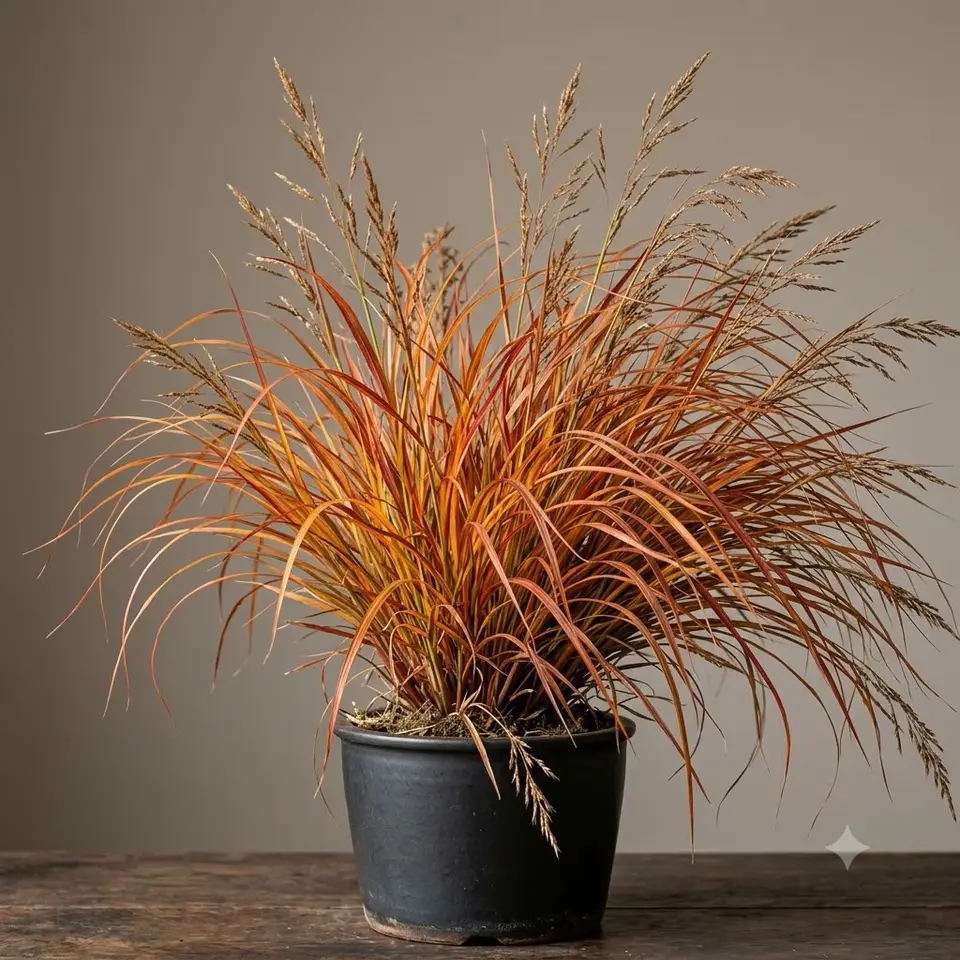 AI illustration
 Overview
Pheasant's Tail Grass is an arching New Zealand evergreen whose olive blades streak orange, amber and red year-round, intensifying with cold and stress into a permanent autumn. For mild-winter gardens it is the finest colored-foliage grass there is. (Anemanthele lessoniana.)
Origin & Natural Habitat
Forest margins and rocky slopes of New Zealand; short-lived but self-renewing. Hardy zones 8-10 (7 with shelter).
Appearance
A flowing fountain 60-90 cm of fine evergreen blades in olive-bronze streaked flame; gauzy purplish flower sprays in summer; the whole plant deepens to embers in winter cold.
Why People Grow It - Qualities & Benefits
- Year-round orange-bronze color: no other grass sustains it
- Evergreen movement and softness
- Light shade tolerance unusual in colored grasses
- Gauzy summer flowering as a bonus
Care
Light: Sun for the strongest fire; happily bright part shade (a little greener).
Water: Average to low; dislikes winter waterlogging.
Soil: Any drained soil.
Temperature & Hardiness: Zones 8-10 reliably; a sheltered wall spot pushes 7. Colder = grow as a magnificent 2-3 year container plant.
Feeding: Little - lean keeps the color hot.
Maintenance: Comb out dead blades; never hard-cut an evergreen fountain. Individual plants live 4-6 years but self-sow modestly - keep a seedling or two coming as understudies (in NZ-adjacent mild climates watch that seeding politely).
Planting & Propagation
Self-sown seedlings transplant perfectly at small size; seed germinates readily. Division is possible young, pointless old - succession by seedling is the species' own plan.
Common Problems & Pests
- Winter kill beyond zone 8
- Short individual lifespan: plan understudies
- Modest self-seeding (usually welcome, occasionally not)
Toxicity & Safety
Non-toxic to pets and people.
Pros & Cons
Pros
- Permanent sunset coloring
- Evergreen grace
- Takes light shade
- Self-renewing colony
Cons
- Tender past zone 8
- Individuals fade by year 5
- Needs combing, not cutting
Best Suited For
- Mild-climate mixed borders
- Big containers (anywhere, summered out)
- Slopes and banks in flowing drifts
- Color-echo schemes with copper and rust
FAQ
Why is mine mostly green?
Youth, shade or rich living - the fire comes with sun, lean soil, maturity and cold snaps. Winter is its best month.
My 5-year-old plant looks tired - revive it?
No: replace it with one of its own seedlings (there will be some nearby). Short individual life, immortal colony - work with the design.
Can I grow it in zone 6?
As a container plant overwintered in a cold porch, beautifully - in the ground it's a one-winter annual there.
Gear for growing pheasant's tail grass
Links go to Amazon or a partner store (such as Adagio Teas) and may earn us a commission at no extra cost to you. As an Amazon Associate we earn from qualifying purchases. We link gear types, not sponsors' picks: you choose the exact product.