'Mister Lincoln' Rose
'Mister Lincoln' is a dark red hybrid tea with a strong damask fragrance, bred by Herbert Swim and Weeks Rose Growers and named an All-America Rose Selections winner in 1965.
Last reviewed: October 2026
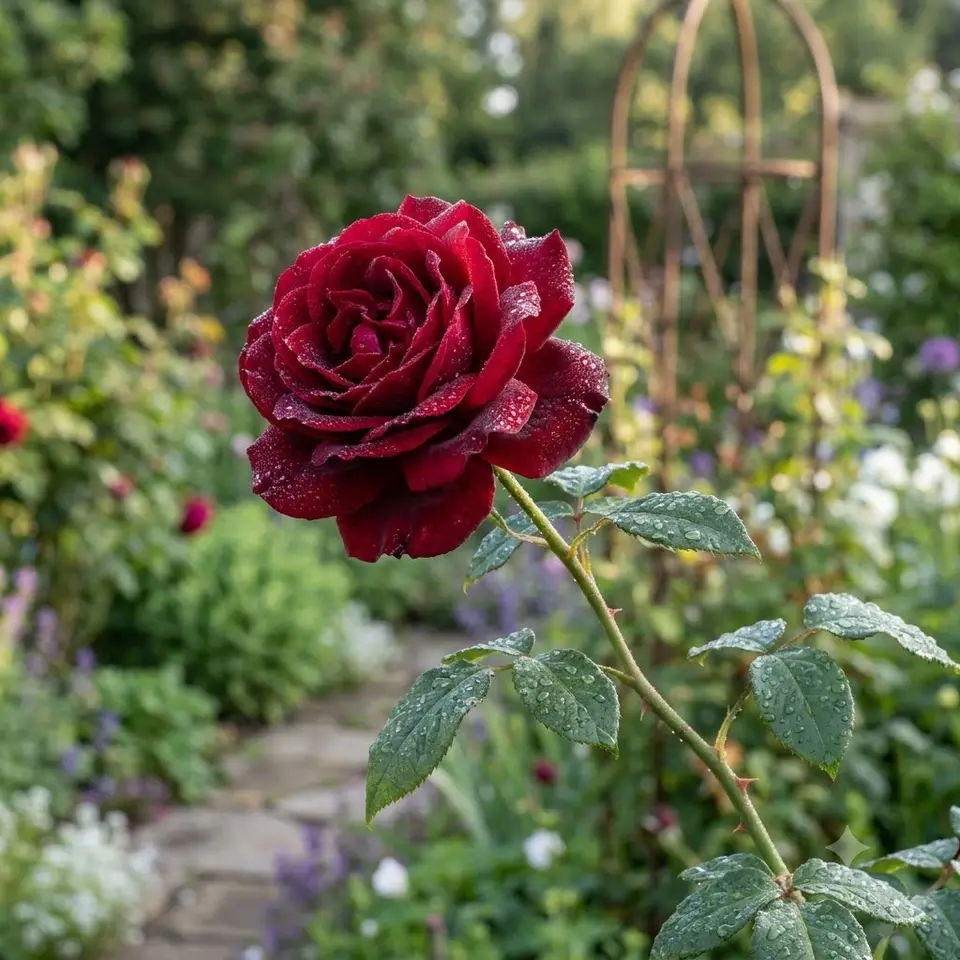 AI illustration
 Overview
'Mister Lincoln' is a dark red hybrid tea with a strong damask fragrance, bred by Herbert Swim and Weeks Rose Growers and named an All-America Rose Selections winner in 1965. Weeks Roses describes large, pointed buds opening to velvety deep red blooms on a tall, vigorous plant with long stems and dark green leaves. (Rosa 'Mister Lincoln', hybrid tea.)
Origin & Natural Habitat
Wikipedia dates the cross to 1964, and both Wikipedia and Weeks Roses give the parents as the hybrid teas 'Chrysler Imperial' and 'Charles Mallerin'. Star Roses introduced it in 1965, and for many years it was the best-selling crimson rose in the United States. Breeders later used it as a parent of 'Big Apple' and 'Dublin', both from 1983.
Appearance
Weeks Roses lists an upright plant of 3-7 feet with 30 to 35 petals per bloom. Wikipedia gives blooms of 6 in (15 cm) or more across, high-centered and generally borne one to a long stem, and says the color does not fade even in the hottest climates. The RHS profile describes crimson red blooms with large, thick petals opening from conical buds, over dark green leaves that are reddish when young.
Why People Grow It - Qualities & Benefits
- Strong damask rose fragrance, in the words of Weeks Roses
- Long stems carrying one bloom each, listed by the RHS for cut flowers
- Deep red petals that Wikipedia says hold their color in heat
- A 1965 winner still listed by Weeks Roses today
Care
Light: Full sun, the only position the RHS and the Chicago Botanic Garden give for it. Weeks Roses adds that it likes consistent warm days and cool nights.
Water: Moist but well-drained soil, as the RHS profile specifies. Water early in the day so the foliage can dry; Purdue Extension gives that advice against both black spot and powdery mildew.
Soil & Feeding: The RHS grows it in fertile, humus-rich soil with a mulch of well-rotted organic matter, and applies a general rose or shrub fertilizer in early spring and again in early summer. Our main rose profile covers feeding in more detail.
Temperature & Hardiness: Weeks Roses rates it for zones 7a-9b. Wikipedia and the Chicago Botanic Garden give zones 5-9, and the RHS gives H6 for British gardens.
Pruning & Maintenance: Prune by the RHS method for hybrid teas (pruning group 15): in late winter shorten the strongest shoots to four to six buds, about 10-15 cm from the base, and weaker ones to two to four buds. At Wisley, the RHS pruning guide adds, the aim is to remove all three-year-old wood, leaving younger growth that flowers better.
Planting & Propagation
Most commercially grown roses are budded onto a vigorous rootstock, and Purdue Extension uses the knob of the bud union as the guide to planting depth. Purdue also plants roses at least 18 to 24 inches away from buildings or other solid barriers. The Chicago Botanic Garden lists it for screens and hedges, beds and borders, and as a specimen plant.
Common Problems & Pests
- Susceptible to blackspot, though Wikipedia calls it generally healthy and heat tolerant
- Rust, powdery mildew and rose dieback, all named as possible diseases in its RHS profile
- Large rose sawfly, aphids and rose leafhopper, pests that may attack it according to the RHS
Toxicity & Safety
Roses are non-toxic to dogs and cats - the thorns are the only hazard.
Pros & Cons
Pros
- Strong damask scent
- Velvety deep red color
- Long stems for cutting
Cons
- Susceptible to black spot
- Weeks Roses' hardiness range starts at zone 7a
- Tall, up to 7 feet by Weeks Roses' figure
Best Suited For
- Cutting gardens
- Regions with warm days and cool nights
- Beds and borders where it can stand behind shorter plants
- Gardens planted for fragrance
FAQ
Who bred 'Mister Lincoln'?
Herbert Swim, working with Weeks Rose Growers; Weeks Roses names the hybridizers as Herbert Swim and O.L. Weeks. Swim also bred Double Delight, introduced in 1977, which the WFRS has inducted into its Hall of Fame.
Does it grow in cooler climates?
It is grown in Britain: the RHS rates it H6, a minimum of -20 to -15 °C on its scale, and suggests it for flower borders and cut flowers. Purdue Extension's list of recommended roses for Indiana, taken from the Illiana Rose Society, also includes it. Weeks Roses, writing for American nurseries, gives zones 7a-9b.
Gear for growing 'mister lincoln' rose
Links go to Amazon or a partner store (such as Adagio Teas) and may earn us a commission at no extra cost to you. As an Amazon Associate we earn from qualifying purchases. We link gear types, not sponsors' picks: you choose the exact product.