'Julia Child' Rose
'Julia Child' is a golden-yellow floribunda bred by Tom Carruth and introduced by Weeks Roses in 2006, the year it won the All-America Rose Selections award.
Last reviewed: October 2026
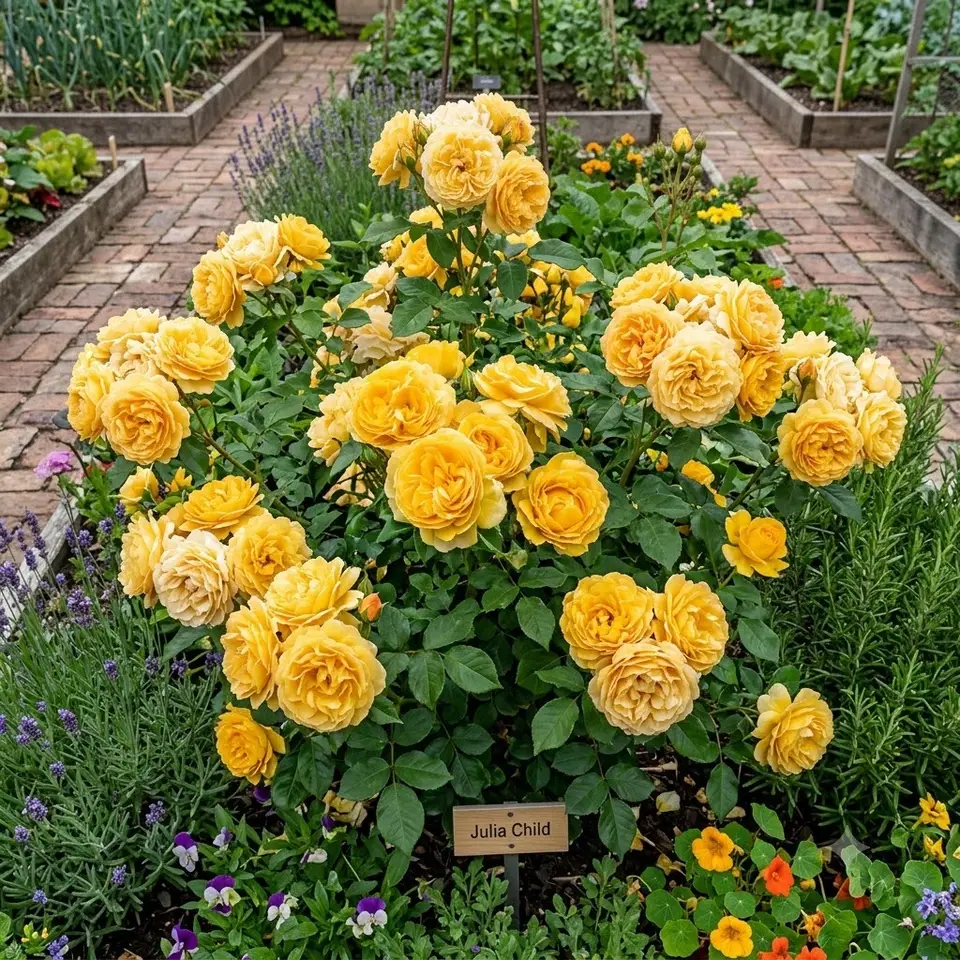 AI illustration
 Overview
'Julia Child' is a golden-yellow floribunda bred by Tom Carruth and introduced by Weeks Roses in 2006, the year it won the All-America Rose Selections award. Weeks Roses writes that the chef selected the rose to bear her name shortly before her death, and that she loved its even butter gold color and licorice candy fragrance. (Rosa 'Julia Child', floribunda.)
Origin & Natural Habitat
Wikipedia dates the breeding to 2004, and Weeks Roses gives the parentage as [(Voodoo x R. soulieana derivative) x Summerwine] x Top Notch, with the cultivar name WEKvossutono. In Britain it was released as 'Absolutely Fabulous', and in Australia as 'Soul Mate'. Besides the 2006 AARS award it was named Best of the Best in 2010 and won the Gold Star of the South Pacific at the 2011 New Zealand Rose Trials.
Appearance
Weeks Roses describes 3-inch old-fashioned blooms with over 35 petals on a very rounded, bushy plant about 3 feet tall with super glossy leaves. NC State Extension gives fully double, ruffled flowers of 26-40 petals, 3-4 inches across, in small clusters, on a compact shrub 2-3 feet tall and wide that can reach 5 feet in warmer climates. Wikipedia describes cup-shaped, globular flowers over bright green foliage.
Why People Grow It - Qualities & Benefits
- Licorice candy and spice fragrance, rated strong by Weeks Roses
- Disease resistance that its introducer rates as excellent
- A compact, rounded shape for containers and small beds
- Nearly continuous bloom from late spring into fall, according to NC State Extension
Care
Light: Full sun, the position NC State Extension gives for it.
Water: Adequate moisture in rich, fertile, well-drained soil, as NC State Extension puts it. Wikipedia describes the rose as heat tolerant.
Soil & Feeding: NC State Extension finds flowering best when a well-balanced fertilizer goes on in late winter or early spring and again in early summer. Deadheading, it adds, encourages more blooms. Read the care section for all roses for the wider routine.
Temperature & Hardiness: Weeks Roses gives zones 6b-9b and calls it consistent, hardy and floriferous in all climates. NC State Extension lists zones 5a to 10b, and Wikipedia 4a through 10a.
Pruning & Maintenance: NC State Extension cuts out old, dead or diseased canes in late winter or early spring and shapes the plant at the same time. Wikipedia says only minimal pruning is needed to keep its shape.
Planting & Propagation
Weeks Roses supplies it budded and on its own roots, and lists US plant patent 18,473 for it. NC State Extension suggests it for containers, borders, walkways and groups, and for pollinator, cutting and cottage gardens.
Common Problems & Pests
- Few leaf diseases: Wikipedia reports excellent resistance to blackspot, and Weeks Roses calls it very disease resistant
- Deer, which NC State Extension says will browse roses
- Prickles on the stems, noted by NC State Extension
Toxicity & Safety
Roses are non-toxic to dogs and cats - the thorns are the only hazard.
Pros & Cons
Pros
- Licorice and spice scent
- Small, rounded habit
- Strong disease ratings from its introducer and Wikipedia
Cons
- Weeks Roses' hardiness range starts at zone 6b
- Prickly stems
- At 2-3 feet, too short for the back of a border
Best Suited For
- Containers
- Pollinator, cutting and cottage gardens
- Edges of walkways
- Small beds and groups
FAQ
Did Julia Child choose this rose herself?
Yes, according to Weeks Roses, which says she selected it to bear her name shortly before her death. NC State Extension notes that the rose was named for the famous chef who loved cooking with butter.
What does it smell like?
Sources describe it slightly differently: licorice candy and spice for Weeks Roses, licorice-clove for NC State Extension, and sweet licorice for Wikipedia.
Gear for growing 'julia child' rose
Links go to Amazon or a partner store (such as Adagio Teas) and may earn us a commission at no extra cost to you. As an Amazon Associate we earn from qualifying purchases. We link gear types, not sponsors' picks: you choose the exact product.