'Graham Thomas' Rose
'Graham Thomas' is a rich yellow English shrub rose from David Austin, introduced in 1983 and named for the British horticulturist Graham Thomas.
Last reviewed: October 2026
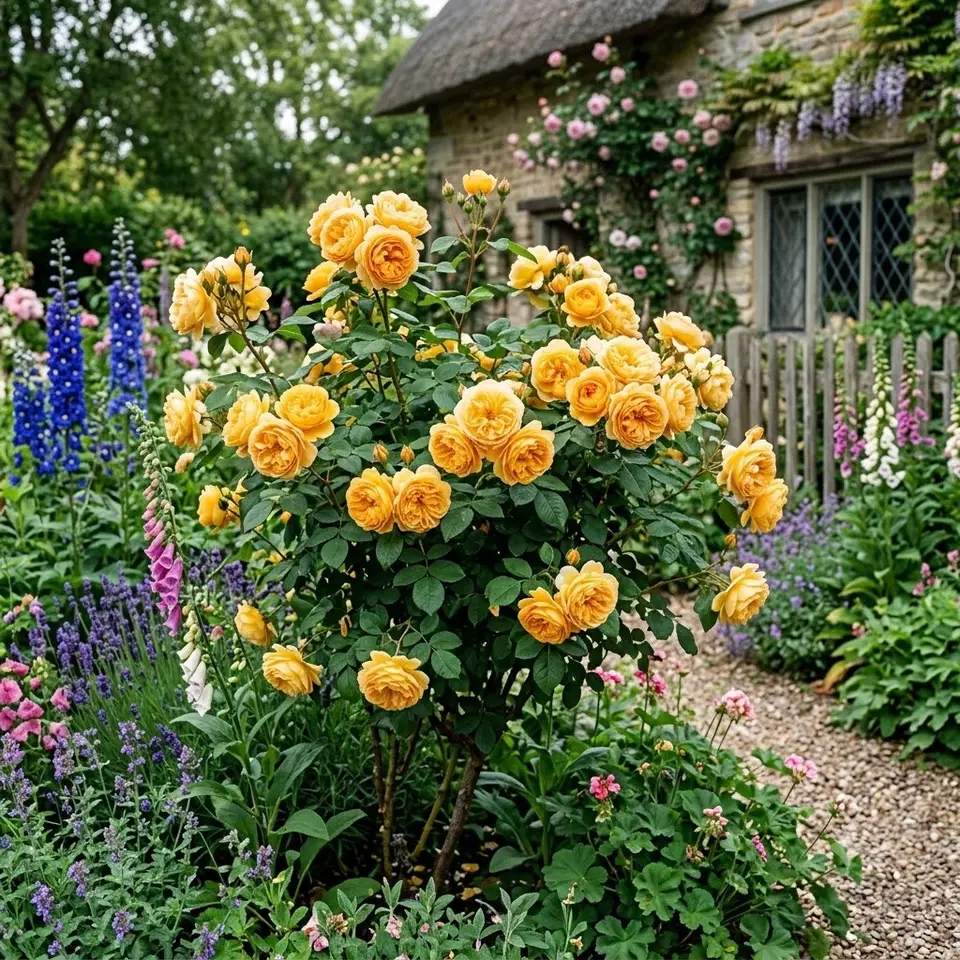 AI illustration
 Overview
'Graham Thomas' is a rich yellow English shrub rose from David Austin, introduced in 1983 and named for the British horticulturist Graham Thomas. In 2009 the World Federation of Rose Societies voted it into its Rose Hall of Fame, and David Austin Roses still offers a limited number of plants, online only. (Rosa 'Graham Thomas', English shrub.)
Origin & Natural Habitat
The WFRS gives its parentage as 'Charles Austin' x ('Iceberg' x seedling), which makes the floribunda Iceberg a grandparent. According to David Austin Roses, Graham Thomas was a frequent visitor to the nursery, offered encouragement and advice, and chose this rose himself. Wikipedia records an RHS Award of Garden Merit in 1993, the first for an Austin rose; the current RHS plant profile does not show the award. Austin used it widely in later breeding, and Wikipedia counts over 20 child plants, among them 'Evelyn' (1992) and 'Charlotte' (1994).
Appearance
David Austin Roses describes medium-sized, cupped blooms of an unusually rich, pure yellow on a bushy, upright, vigorous shrub with smooth green foliage, 4 ft (125 cm) high and wide at three years old. NC State Extension adds apricot-pink buds, flowers 3-4 inches wide with 26-40 petals that fade to pale lemon with age, and a height of 4-10 feet, taller in warm climates.
Why People Grow It - Qualities & Benefits
- A deep, pure yellow that the WFRS and David Austin Roses both single out
- Tea fragrance: light with a cool violet character for David Austin Roses, strong for the WFRS and NC State Extension
- Can be trained as a short climber to 2.4 m, according to the RHS
- Golden hips in autumn if deadheading stops, as NC State Extension notes
Care
Light: Full sun or partial shade (RHS); David Austin Roses suggests an east-, south- or west-facing site.
Water: NC State Extension asks for amended, well-drained, moist soil. David Austin Roses advises keeping foliage and flowers dry, because moisture sitting on leaves overnight encourages black spot.
Soil & Feeding: All soil types suit it, according to David Austin Roses. The RHS asks for fertile, humus-rich ground, applies a balanced fertilizer and mulch as winter ends or in early spring, and feeds again in early summer. For the general routine, our guide to growing roses has more.
Temperature & Hardiness: Hardiness rating H6 from the RHS, its band for a minimum of -20 to -15 °C. NC State Extension lists USDA zones 5a to 10b.
Pruning & Maintenance: As a shrub it belongs to RHS pruning group 21; trained as a climber it follows group 17. NC State Extension prunes it in late fall. Its stems are stiff: Wikipedia says the rigid stems and upright habit make it difficult to train as a climber, and NC State calls it trainable with persistence.
Planting & Propagation
This rose is sold bare-root by David Austin Roses, for planting from October to April. The RHS propagates it by softwood cuttings in early to mid spring, hardwood cuttings in late summer to autumn, or chip budding in summer.
Common Problems & Pests
- Weaker disease resistance than newer Austin roses: David Austin Roses says it does not offer the disease resistance or vigorous repeat flowering of its modern introductions, and suggests 'The Poet's Wife' as a healthier alternative
- Powdery mildew, rust and black spot, which its RHS profile lists as possible diseases
- Aphids and large rose sawfly, two of the pests the RHS names for it
Toxicity & Safety
Roses are non-toxic to dogs and cats - the thorns are the only hazard.
Pros & Cons
Pros
- Rich, pure yellow
- Tea fragrance
- Shrub or short climber
Cons
- Less disease resistant than newer Austin roses, by its breeder's own account
- Short-lived flowers, which Wikipedia says do not make good cut flowers
- Stiff canes make climber training slow
Best Suited For
- Borders, pots and rose hedges, the uses David Austin Roses lists
- Cottage and informal gardens
- Walls, as a short climber
- Collections of historic English roses
FAQ
Shrub or climber?
Both. The RHS describes an upright shrub of about 1.2 m that can be grown as a short climber to 2.4 m. The canes are stiff, so training it up a wall takes time.
Who was Graham Thomas?
A British horticulturist whom David Austin Roses calls one of the most influential gardeners of his time. He gathered a collection of Old Roses that formed the basis of the National Collection at Mottisfont Abbey in Hampshire.
Gear for growing 'graham thomas' rose
Links go to Amazon or a partner store (such as Adagio Teas) and may earn us a commission at no extra cost to you. As an Amazon Associate we earn from qualifying purchases. We link gear types, not sponsors' picks: you choose the exact product.