English Bluebell
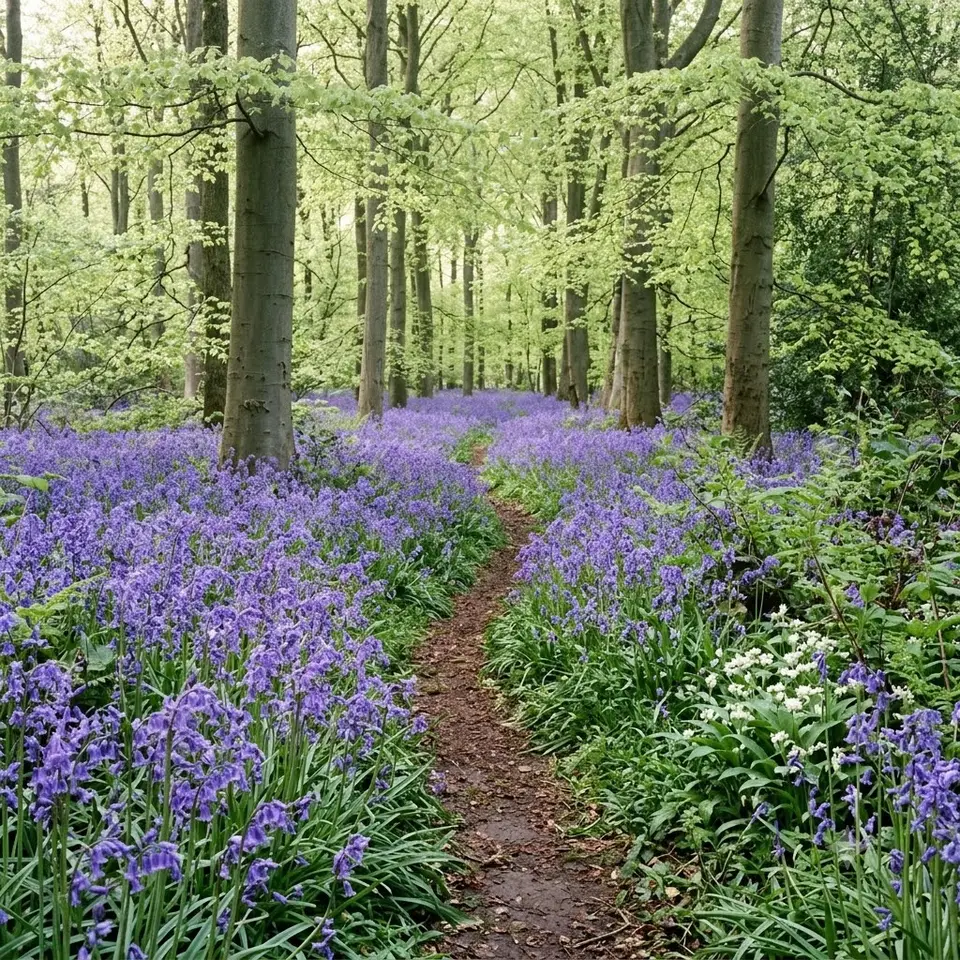
The English bluebell floods British beech woods each May with a violet-blue, honey-scented haze.
Last reviewed: October 2026
 AI illustration
 Overview
The English bluebell floods British beech woods each May with a violet-blue, honey-scented haze. In gardens it asks only shade and patience: plus one crucial act of citizenship: planting TRUE non-scripta, not the pushy Spanish impostor. (Hyacinthoides non-scripta.)
Origin & Natural Habitat
Western Europe's ancient woodlands - half the world's population blooms in Britain; a protected, culturally sacred flower.
Appearance
30-40 cm arching one-sided stems of narrow deep violet-blue bells with cream pollen and real fragrance - the droop and the scent distinguish it; May.
Why People Grow It - Qualities & Benefits
- THE woodland experience, home edition
- True fragrance (Spanish have none)
- Ancient-wood romance and wildlife value
- Self-builds into blue mist over years
Care
Light: Deciduous shade - the beech-oak understory contract.
Water: Woodland spring moisture; summer dormant.
Soil: Humusy, leafmoldy, drained.
Planting: Fresh bulbs early fall 10 cm deep, or in-the-green divisions in spring - AND buy certified non-scripta from cultivated stock (wild collection is illegal in the UK; the trade's mislabeling is rife).
Hardiness: Zones 5-8 (mild-maritime happiest).
After flowering: Leave everything to yellow; colonies take years then take over (in the good way, in shade).
Propagation
Self-seed + offsets; share in-the-green like snowdrops.
Common Problems & Pests
- THE issue: hybridization: Spanish/hybrid bluebells (upright, scentless, blue pollen) cross with and genetically swamp natives; never plant them near true colonies, and rogue out uprights
- Otherwise carefree in shade
Toxicity & Safety
Toxic if eaten (glycosides) - historic glue-and-starch plant, modern look-don't-nibble; rodent-proof accordingly.
Pros & Cons
Pros
- Matchless blue + scent + story
- Permanent shade asset
- Wildlife-approved
Cons
- Slow build (years to haze)
- Must source true stock carefully
- Summer absence
Best Suited For
- Deciduous shade and woodland gardens
- Under old fruit trees
- British-romantic plantings anywhere temperate
- Conservation-minded gardeners
FAQ
How do I tell English from Spanish?
English: one-sided drooping stems, narrow deep-blue scented bells, CREAM pollen. Spanish: upright stems, wide pale unscented bells, BLUE pollen. If it stands straight and smells of nothing - it's the impostor.
Why does planting the right one matter?
Spanish genes flow into native populations and dilute them permanently - gardens near any wild or naturalized colony carry real responsibility. Certified non-scripta only; it's also simply the better plant.
Gear for growing english bluebell
Links go to Amazon or a partner store (such as Adagio Teas) and may earn us a commission at no extra cost to you. As an Amazon Associate we earn from qualifying purchases. We link gear types, not sponsors' picks: you choose the exact product.