Santa Rosa Plum
Plum variety
Luther Burbank's 1906 masterpiece - the crimson Japanese plum with amber flesh and perfect sweet-tart balance that made 'plum flavor' mean Santa Rosa across half the world.
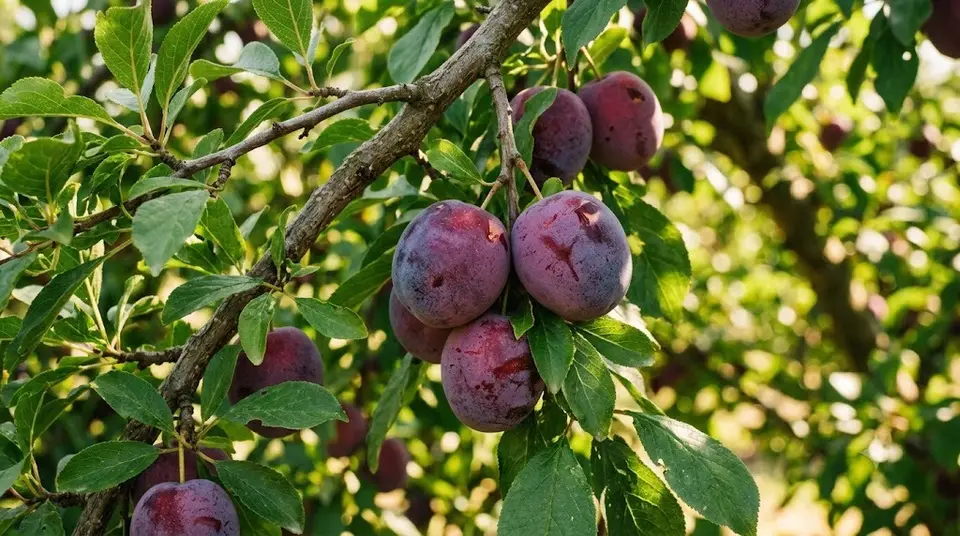
Santa Rosa is the plum against which plums are judged - Luther Burbank's most famous creation, a crimson-purple Japanese type whose amber flesh runs sweet at the pit and tangy at the skin, so each bite is its own sweet-sour arc. Add early ripening, partial self-fertility, and vigor in almost any soil, and you have one of the most-planted backyard plums of the last century.
Fruit & flavor
Medium-large, deep crimson with a silvery bloom; amber flesh, juicy and richly aromatic - sweet at the center, briskly tart at the skin. Wonderful fresh, and the tang makes superior jam.
Tree size & rootstocks
Vigorous, upright-spreading Japanese plum: 3-4 m on Citation or St. Julien, more on Myrobalan. Precocious - fruit by year 3.
Pollination
Partially self-fertile - a lone tree crops respectably, and a second Japanese plum (Methley, Satsuma, Burbank) doubles it. Note Japanese and European plums don't cross-pollinate.
Climate & hardiness
Zones 5-9 with low chill needs and great heat tolerance - the Japanese plum advantage. Its early bloom is the one risk in frost-pocket gardens.
Site & soil
Full sun, any reasonable drained soil; famously unfussy - Burbank bred it for real-world orchards.
Pruning & care
Japanese plums grow like teenagers: summer-prune hard to an open vase, thin fruit to 8-10 cm apart (they overset wildly and snap limbs), and that's the whole job.
Harvest & storage
June-July; pick when the bloom dusts over deep color and flesh gives slightly. Ripens off the tree from firm-mature; fridge life ~1 week, jam and freezer after.
Problems
Brown rot in humid weather, aphid curl on new growth, bacterial spot in the Southeast; branch breakage from overcropping is the self-inflicted one - thin!
FAQ
Why did half my crop drop in early summer?
'June drop' - the tree self-thinning an overset; it's normal. Beat it to the punch by thinning earlier and the remaining fruit sizes up.
Santa Rosa or an European plum?
Santa Rosa for fresh eating and low-chill climates; Europeans (Stanley, Victoria) for drying, baking and colder zones.
Varieties behave differently by region, rootstock and season - ripening months here assume a mid-temperate northern-hemisphere garden. Check local nursery guidance for your exact climate, and never rely on a single source for spray decisions.
Kit for fruit trees
Links go to Amazon or a partner store (such as Adagio Teas) and may earn us a commission at no extra cost to you. As an Amazon Associate we earn from qualifying purchases. We link gear types, not sponsors' picks: you choose the exact product.