Rainier Cherry
Cherry variety
Rainier is the golden luxury cherry - cream-yellow blushed red, honey-sweet with almost no acid, so delicate it commands triple prices; homegrown, it's a revelation no store fruit matches.
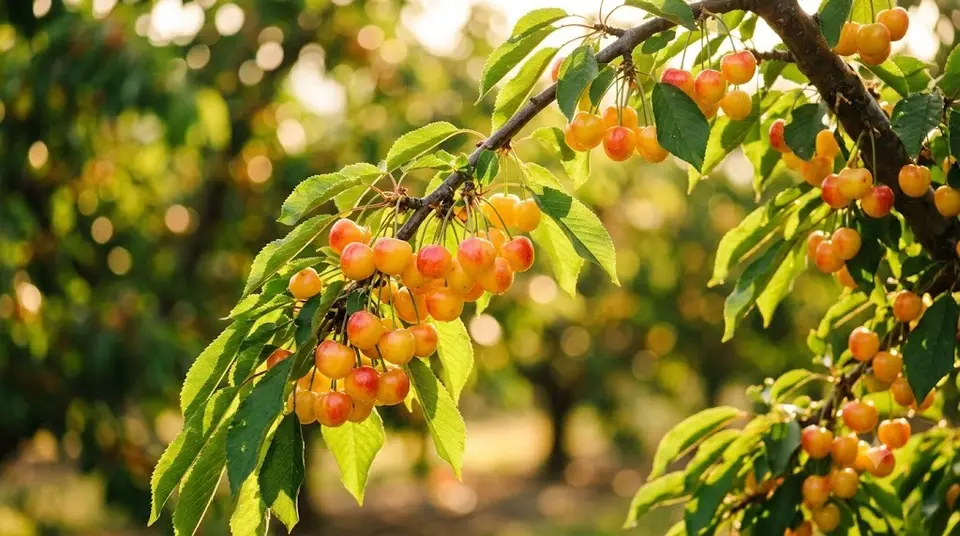
Rainier (Washington State's 1952 cross of Bing and Van) is the cherry sold in tiny, expensive clamshells: translucent gold blushed with crimson, honey-sweet, and so thin-skinned it bruises if you look at it sternly. That fragility is exactly why growing your own matters: a Rainier eaten warm from the tree, at full sugar, unbruised, is arguably the finest single fruit a temperate garden produces.
Fruit & flavor
Large, cream-to-gold with a red sun blush; the flesh is pale, tender and intensely honeyed - very high sugar over whisper-low acid. Milder-tasting than dark cherries and utterly distinctive.
Tree size & rootstocks
Same species and scale as Bing - buy it on Gisela 5 (≈3 m, netable) or Colt for gardens; vigorous and productive either way.
Pollination
Self-sterile; Bing, Stella, Lapins or Van pollinate it (and it pollinates them back - a Bing+Rainier pair is the classic double planting).
Climate & hardiness
Zones 5-8, same dry-June preference as all sweets; the pale skin shows every rain-mark and bird peck, so climate and netting matter even more.
Site & soil
Full sun (the blush and sugar are sun-made), deep drained soil, no wet feet, airflow for the delicate fruit.
Pruning & care
Late-summer pruning only; net without fail - birds hit yellow cherries as hard as dark ones once they learn, and every peck ruins a fruit that can't hide bruises. Handle harvest by the stems.
Harvest & storage
Late June-July, when the blush deepens and the gold warms - taste is the only true test. Eat within days; this variety was never built to store.
Problems
Everything Bing suffers plus visible bruising: cracking, birds, brown rot, canker. It is a 'grow it because the store version disappoints' fruit - protection pays.
FAQ
Why are store Rainiers so expensive?
Every fruit must be hand-picked by the stem, unbruised, and shipped fast - you're paying for logistics your backyard doesn't need.
My Rainiers taste bland - why?
Picked too early. The low acid means under-ripe fruit reads watery; wait for full blush and a deep honey note.
Varieties behave differently by region, rootstock and season - ripening months here assume a mid-temperate northern-hemisphere garden. Check local nursery guidance for your exact climate, and never rely on a single source for spray decisions.
Kit for fruit trees
Links go to Amazon or a partner store (such as Adagio Teas) and may earn us a commission at no extra cost to you. As an Amazon Associate we earn from qualifying purchases. We link gear types, not sponsors' picks: you choose the exact product.