Granny Smith Apple
Apple variety
The world's green apple - a chance Australian seedling that became the definitive tart baking apple, thriving in warm climates that defeat most varieties and keeping all winter.
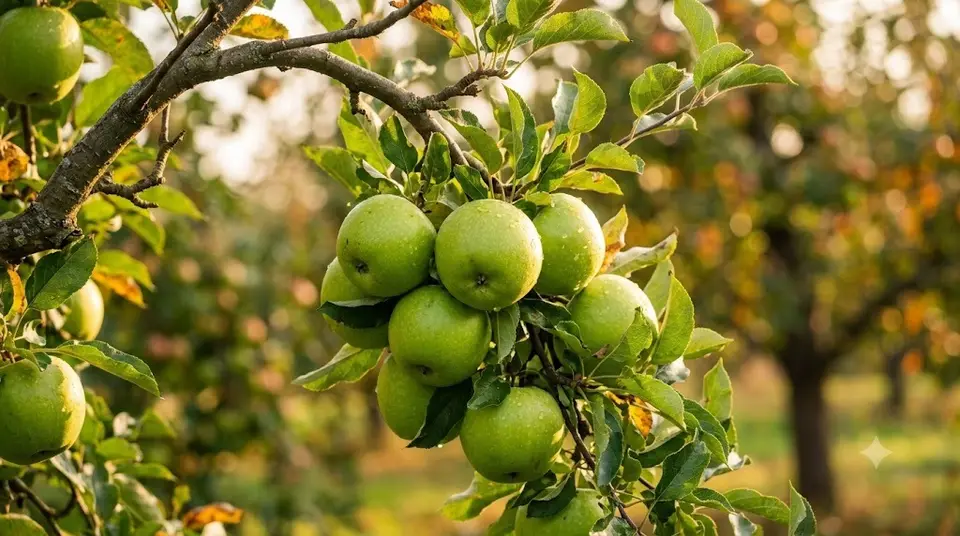
Granny Smith sprouted from a compost heap in 1860s Australia - Maria Smith's lucky seedling became the most recognizable apple on Earth. In the garden it is a workhorse: heat-loving, low-chill, heavy-bearing and late-ripening, producing the hard, acid, grass-green fruit that holds its shape in every pie and mellows to a decent fresh eater after storage.
Fruit & flavor
Medium-large, uniformly bright green (blushing faint pink in strong sun), with hard, ultra-crisp flesh and bracing acidity. The benchmark baking apple - and after two months in the fridge it sweetens into a genuinely good tart dessert apple.
Tree size & rootstocks
Moderately vigorous and wide-spreading; 2.5-3 m on M9, ~4 m on MM106. Bears young and heavily, often on tip-bearing wood - go easy on shortening cuts.
Pollination
Partially self-fertile with a useful solo crop; Gala or Fuji nearby lifts it to full production. Late bloom pairs it naturally with other late varieties.
Climate & hardiness
Zones 5-9 with a famously low chill need (one of the best apples for warm-winter regions), but it needs the long season: 170-190 days to ripen properly. In cold-short climates the fruit stays a sour green bullet.
Site & soil
Full sun, well-drained soil, pH 6.0-7.0; tolerates heat and light drought better than most apples once established.
Pruning & care
Minimal: open the canopy in winter, thin heavy sets, and respect the partial tip-bearing habit (thin whole spurs rather than tipping everything). A very forgiving tree.
Harvest & storage
October-November; pick when the green lightens and seeds darken - early-picked fruit is purely a cooker. Stores 4-6 months chilled, arguably improving for the first two.
Problems
Sunburn on exposed fruit in hot regions (leave protective leaf cover), scab in wet climates, bitter pit occasionally in big fruit. Overall one of the tougher varieties.
FAQ
Can I eat it fresh or is it only for pies?
Tree-fresh it is aggressively tart; after 4-8 weeks in cold storage the starch converts and it becomes a crisp, tangy eating apple many people prefer.
Why won't my Granny Smith ripen before frost?
It needs one of the longest seasons of any apple - in short-summer climates choose an earlier tart variety instead.
Varieties behave differently by region, rootstock and season - ripening months here assume a mid-temperate northern-hemisphere garden. Check local nursery guidance for your exact climate, and never rely on a single source for spray decisions.
Kit for fruit trees
Links go to Amazon or a partner store (such as Adagio Teas) and may earn us a commission at no extra cost to you. As an Amazon Associate we earn from qualifying purchases. We link gear types, not sponsors' picks: you choose the exact product.