Bartlett Pear
Pear variety
Bartlett (Williams) is the world's pear - the fragrant yellow classic behind every canned half and pear drop, an easy heavy cropper that defines 'pear flavor' and starts every home orchard.
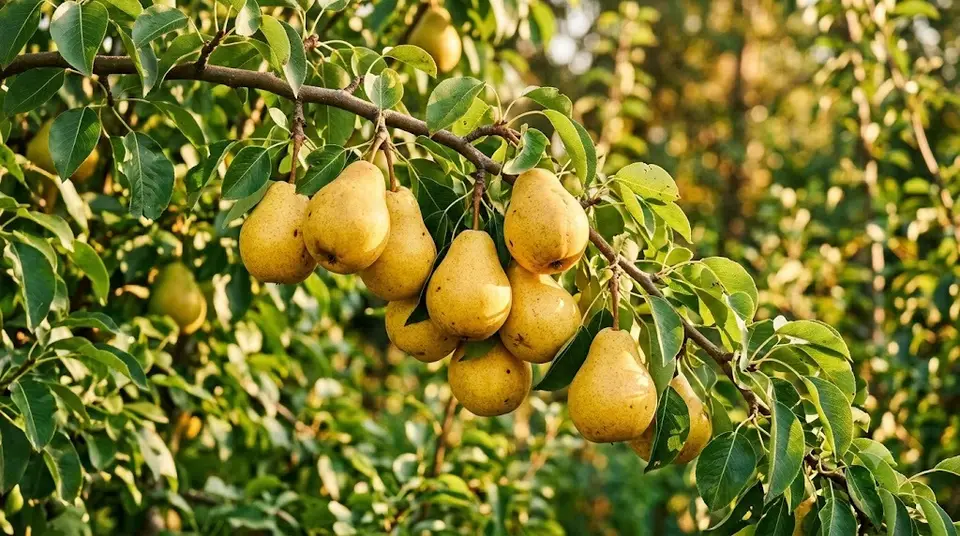
Bartlett (Williams' Bon Chrétien in the Old World) is one of the most widely grown pears on Earth for the simplest reason: it is very good and very easy. A heavy annual bearer of aromatic golden fruit that ripens off the tree to dripping, buttery smoothness, it cans, bottles, dries and eats better than varieties twice as fussy. If a garden has one pear, it is almost always this one.
Fruit & flavor
Medium-large, classic pear-shaped, green ripening to fragrant yellow; the melting white flesh carries the definitive musky 'pear drop' aroma. Superb fresh, and THE canning pear - it holds shape and flavor through processing.
Tree size & rootstocks
Naturally upright and vigorous; on quince rootstock (with compatible interstem) a manageable 3-4 m, on pear seedling 6 m+. Trains beautifully as espalier.
Pollination
Partially self-fertile in warm districts but always better with a partner - Anjou, Bosc or Comice all overlap. (Note: Bartlett and Seckel famously don't cross well.)
Climate & hardiness
Zones 5-8; needs moderate chill and a warm summer. In cold zone 4 gardens choose hardy hybrids; in the tropics nothing doing - pears are temperate to the bone.
Site & soil
Full sun; pears tolerate heavier, damper soil than apples - deep loam pH 6.0-7.0 ideal. Avoid frost pockets: pear blossom opens early.
Pruning & care
Prune lightly in winter for an open pyramid - hard cutting provokes vertical watersprouts and fireblight-vulnerable lush growth. Thin clusters to 1-2 fruit.
Harvest & storage
THE pear rule: pick hard and ripen indoors. Harvest August-September when full-size, still green, and the stem parts with an upward twist; ripen at room temperature 4-7 days until the neck yields. Tree-ripened Bartletts turn mealy and brown-hearted.
Problems
Fireblight is the great pear enemy - prune strikes 30 cm below damage in dry weather and never over-fertilize. Pear psylla and codling moth where endemic; scab on wet-leaf sites.
FAQ
Why are my pears grainy and brown inside?
They ripened on the tree. Pick them hard-green and mature, then ripen on the counter - the whole secret of good pears.
How do I know picking time if they're still green?
Lift a fruit horizontal: if the stem releases cleanly at the spur, the picking window is open.
Varieties behave differently by region, rootstock and season - ripening months here assume a mid-temperate northern-hemisphere garden. Check local nursery guidance for your exact climate, and never rely on a single source for spray decisions.
Kit for fruit trees
Links go to Amazon or a partner store (such as Adagio Teas) and may earn us a commission at no extra cost to you. As an Amazon Associate we earn from qualifying purchases. We link gear types, not sponsors' picks: you choose the exact product.