Tiger Jaws
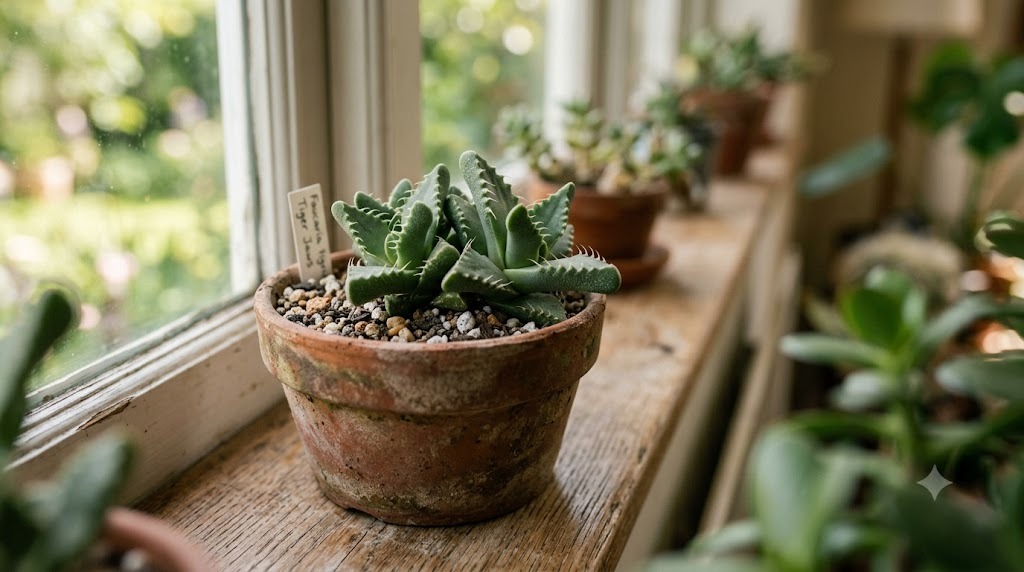
Tiger jaws is a small, characterful succulent whose fat triangular leaves are edged with soft, curved teeth that meet like a pair of gaping jaws.
Last reviewed: July 2026
Overview
Tiger jaws is a small, characterful succulent whose fat triangular leaves are edged with soft, curved teeth that meet like a pair of gaping jaws. Far more forgiving than the living stones it resembles, it flowers with bright yellow daisies in autumn and is an easy, fun choice for a sunny windowsill.
Origin & Natural Habitat
Faucaria tigrina is a mesemb from the Eastern Cape of South Africa, growing in rocky, sharply drained ground. It is one of the easiest and most forgiving of the toothed mesembs, and copes with a wide range of conditions.
Appearance
Low clusters of thick, fleshy, triangular grey-green leaves, often flecked with tiny white dots, their margins lined with soft, whisker-like recurved teeth so that each pair of leaves looks like an open, toothy mouth. Large, glossy yellow daisy-like flowers open in autumn.
Why People Love It - Qualities & Benefits
People love the toothy 'jaws' novelty, the compact clustering habit, the bright autumn flowers, and how genuinely easy it is compared with fussier mesembs like lithops. It is a fun, forgiving talking point.
Care
Light
Bright light with several hours of direct sun keeps the jaws tight, well-coloured and flowering - a sunny windowsill is ideal. Too little light and the leaves stretch, splay and open loosely.
Watering
Soak when the gritty soil has dried out, then wait; water most in its cooler growing seasons (autumn and spring) and keep it much drier in the heat of high summer and in winter. It is more tolerant than lithops but still rots if kept wet.
Soil & Potting
A gritty, sharply draining succulent or cactus mix in a pot with drainage. Good drainage keeps the roots healthy and the clusters firm.
Humidity & Temperature
Dry, airy conditions suit it; it dislikes humidity. Ordinary dry room air is fine. Keep it frost-free and drier over winter.
Feeding
A much-diluted succulent feed once in the growing season is plenty. It thrives on lean soil and needs little.
Repotting
Repot every couple of years in the growing season as the clump fills the pot, dividing the clustered heads if you wish. Settle into fresh gritty mix and wait a few days before watering.
Propagation
Easy by division of the clustering heads, or from seed. Separate a rooted head, pot it into gritty mix, and keep barely moist until it establishes. Leaf cuttings are less reliable than division.
Common Problems & Pests
Overwatering rot is the main risk, especially in summer dormancy and winter. Mealybugs can hide among the leaves. Stretched, floppy, pale growth means too little light; wrinkled leaves mean it is thirsty.
Toxicity & Safety
Tiger jaws is not toxic to people or pets - the 'teeth' are soft and harmless - making it a safe, fun choice around children and animals, though it is best not to let pets chew it.
Pros & Cons
Pros: fun toothy novelty, easy and forgiving for a mesemb, bright autumn flowers, compact, non-toxic. Cons: still rots if overwatered, needs good light to stay tight, wants a drier summer and winter rest.
Best Suited For
A great, low-fuss curiosity for beginners and windowsill collectors who want the mesemb look without the fussiness of living stones - easy, characterful and cheerful in bloom.
FAQ
Are the teeth sharp? No - the 'jaws' teeth are soft, whisker-like and completely harmless.
When does it flower? Usually in autumn, with large glossy yellow daisy-like flowers, given enough light.
Gear for growing tiger jaws
Links go to Amazon or a partner store (such as Adagio Teas) and may earn us a commission at no extra cost to you. As an Amazon Associate we earn from qualifying purchases. We link gear types, not sponsors' picks: you choose the exact product.