Stapelia (Starfish Flower)
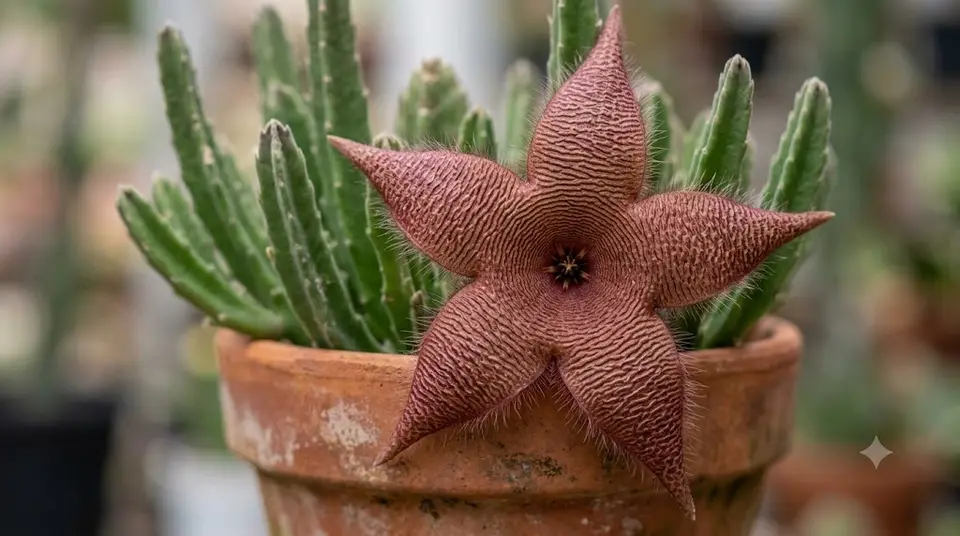
The stapelia is a leafless clumping succulent grown for one of the most extraordinary flowers in the plant world: a huge, five-pointed, often hairy star that can be the size of a saucer - and smells of rotten meat to attract the flies that pollinate it.
Last reviewed: October 2026
 AI illustration
 Overview
The stapelia is a leafless clumping succulent grown for one of the most extraordinary flowers in the plant world: a huge, five-pointed, often hairy star that can be the size of a saucer - and smells of rotten meat to attract the flies that pollinate it. Bizarre, fascinating and surprisingly easy, it is a true novelty for the adventurous grower.
Origin & Natural Habitat
Stapelia species come from the dry regions of southern Africa, where they grow in the shade of rocks and shrubs. Their carrion-scented, fly-pollinated flowers are an adaptation to their arid home - a strange but effective strategy.
Appearance
Clumps of upright, soft, four-angled green stems with no leaves, sometimes flushing red in strong sun. The flowers are the spectacle: large, star-shaped, five-pointed blooms, often wrinkled and covered in fine hairs, in mottled reds, browns and yellows - and famously scented of rotting meat when open, to lure pollinating flies.
Why People Love It - Qualities & Benefits
People grow it for the sheer novelty and drama of those enormous starfish flowers, the fascination of a plant that mimics carrion, and how easy it is despite its exotic looks. It is a favourite curiosity for collectors who love the strange.
Care
Light
Bright light with some direct sun, but with a little shade from the fiercest midday glare, reflecting its habit of growing among rocks and shrubs. Good light keeps the stems firm and encourages flowering; deep shade gives weak growth.
Watering
Soak when the soil is fully dry, then wait; water moderately in the growing season and keep it much drier in winter. The soft stems rot easily, so err dry - overwatering, especially when cool, is the main killer.
Soil & Potting
A gritty, very free-draining succulent mix in a pot with drainage. Sharp drainage is essential for the rot-prone stems and roots.
Humidity & Temperature
Warm, dry, airy conditions suit it; it dislikes humidity and stuffy air. Keep it above about 10°C and drier over winter.
Feeding
A much-diluted succulent feed once or twice in the growing season is ample. It needs little feeding.
Repotting
Repot every couple of years in spring as the clump spreads, dividing it if you wish. Handle the soft stems gently and settle into fresh gritty mix, waiting a few days before watering.
Propagation
Very easy by division or stem cuttings: detach a stem, let the cut end callus for several days, and set it in gritty mix to root. Clumps divide readily.
Common Problems & Pests
Stem and root rot from overwatering, especially in winter, is the main danger - soft, blackening stems are the sign. Mealybugs can appear. The flowers' rotten-meat smell can attract flies indoors, so many growers enjoy the blooms outdoors or in a porch.
Toxicity & Safety
The stapelia is not toxic to people or pets (only its smell is offensive) making it a safe, if pungent, curiosity to grow, though it is still best to discourage pets from chewing it.
Pros & Cons
Pros: extraordinary huge starfish flowers, fascinating carrion-mimic novelty, easy and easy to propagate, non-toxic. Cons: flowers smell of rotting meat and can attract flies, soft stems rot easily if overwatered, leafless stems are plain out of bloom.
Best Suited For
A brilliant curiosity for adventurous collectors who want one of the strangest flowers in the plant world - just be ready for the smell, and keep it lean and dry.
FAQ
Why does the flower smell so bad? It mimics rotting meat to attract the flies that pollinate it - the smell is the whole point.
Why are the stems going soft and black? Rot from overwatering, especially when cool - water much more sparingly and improve drainage.
Gear for growing stapelia (starfish flower)
Links go to Amazon or a partner store (such as Adagio Teas) and may earn us a commission at no extra cost to you. As an Amazon Associate we earn from qualifying purchases. We link gear types, not sponsors' picks: you choose the exact product.