Split Rock (Pleiospilos nelii)
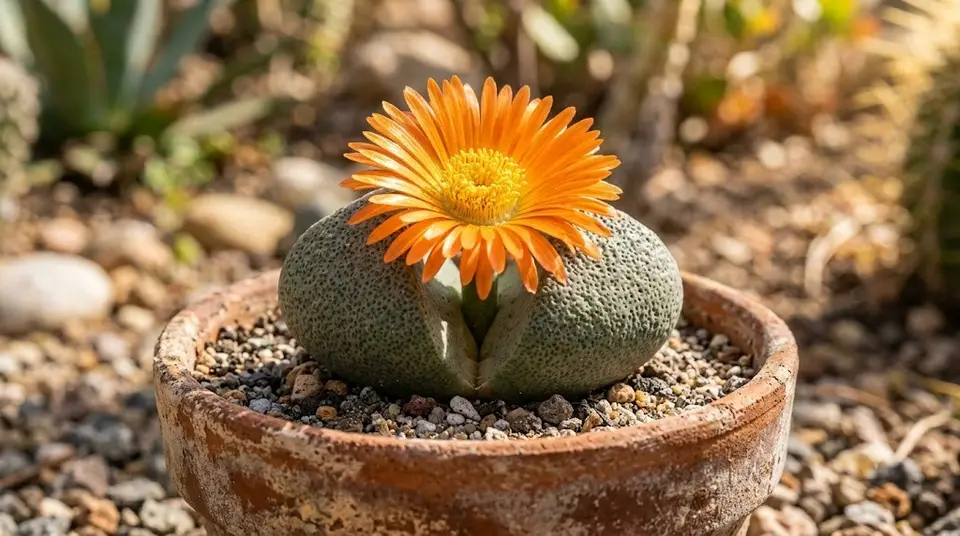
The split rock is a living-stone succulent that looks exactly like a granite pebble cracked in two - until a huge orange or pink daisy flower erupts from the split.
Last reviewed: October 2026
 AI illustration
 Overview
The split rock is a living-stone succulent that looks exactly like a granite pebble cracked in two - until a huge orange or pink daisy flower erupts from the split. It is a fascinating, compact mimicry plant with one golden rule: water it almost never.
Origin & Natural Habitat
Pleiospilos nelii comes from the arid Karoo of South Africa, where it mimics the surrounding stones to hide from grazers and survives on meagre rain and heavy dew. That desert thrift is exactly what its care must copy.
Appearance
One or two pairs of extremely thick, hemispherical grey-green leaves speckled with dark dots, split down the middle like a cracked rock. New leaf pairs emerge from the split, and mature plants open large, silky orange (sometimes pink or yellow) daisy flowers in autumn.
Why People Love It - Qualities & Benefits
People love the perfect stone disguise, the shock of the huge flower from something so rock-like, and the tiny footprint. It is a desert curiosity that lives happily in a teacup-sized pot.
Care
Light
Several hours of direct sun (a south-facing sill) keeps it compact, well-coloured and able to flower. In shade it bloats, stretches and loses the stone look.
Watering
The make-or-break rule: water only when the old leaf pair has visibly wrinkled and, crucially, never while a new pair is drawing down the old one - the plant recycles the old leaves' water. In practice that means a few waterings a year. More split rocks die of kindness than of neglect, and a plant stacking multiple leaf pairs is being overwatered.
Soil & Potting
An almost purely mineral mix (grit, pumice, coarse sand with a little soil) in a small pot with drainage. Rich or moisture-holding mixes are fatal.
Humidity & Temperature
Dry, airy conditions; humidity is unwelcome. Keep it frost-free; it tolerates cool, dry winters well.
Feeding
Little to none - at most a very dilute succulent feed once a year. It is built for poverty.
Repotting
Rarely - every few years, in a deep-enough small pot to take its surprisingly long taproot. Disturb the roots as little as possible and do not water for a week after.
Propagation
Usually from seed, sown on gritty mix - division is possible only on old multi-headed plants and is risky. Seedlings are slow but rewarding.
Common Problems & Pests
Overwatering is virtually the only killer: bursting, mushiness, or a plant piling up several leaf pairs at once all mean too much water. Mealybugs occasionally. If in doubt, do not water.
Toxicity & Safety
The split rock is not toxic to people or pets - a safe, if slightly indestructible-looking, curiosity to have around animals.
Pros & Cons
Pros: astonishing stone mimicry, huge autumn flower, tiny footprint, non-toxic. Cons: unforgiving of overwatering, needs strong sun, mostly seed-grown and slow.
Best Suited For
For careful waterers and desert-plant fans who enjoy a plant that thrives on being ignored almost completely.
FAQ
How often should I water it? Only a few times a year - when the old leaves wrinkle and never while a new pair is absorbing the old.
Why is mine stacking many leaf pairs? That's the classic sign of overwatering - stop, and let it consume the old pairs.
Gear for growing split rock (pleiospilos nelii)
Links go to Amazon or a partner store (such as Adagio Teas) and may earn us a commission at no extra cost to you. As an Amazon Associate we earn from qualifying purchases. We link gear types, not sponsors' picks: you choose the exact product.