Paddle Plant (Flapjacks)
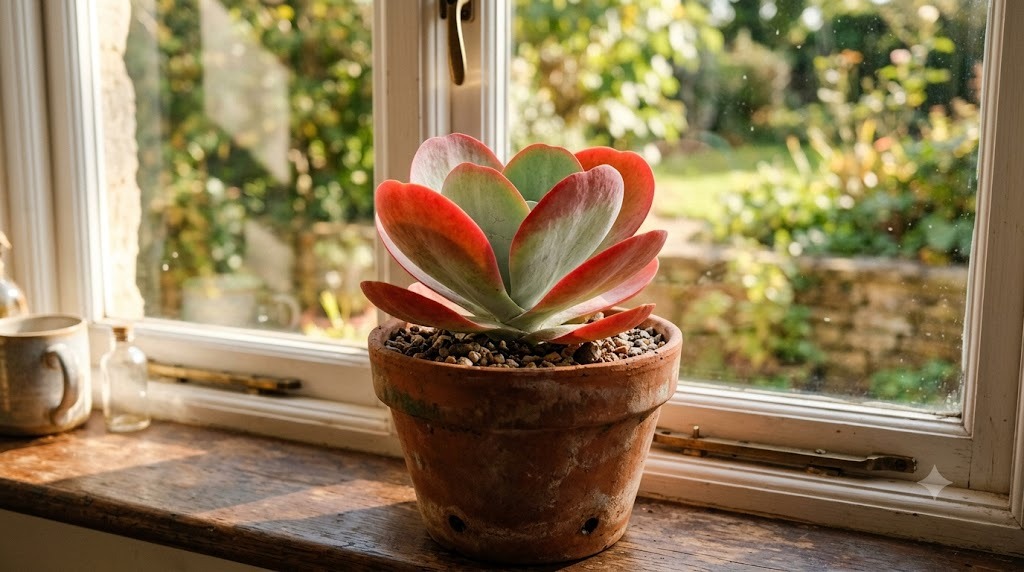
The paddle plant, or flapjacks, is a bold succulent that stacks big, flat, rounded leaves like a pile of pancakes - and in strong sun and cool weather flushes their edges a brilliant, glowing red.
Last reviewed: July 2026
Overview
The paddle plant, or flapjacks, is a bold succulent that stacks big, flat, rounded leaves like a pile of pancakes - and in strong sun and cool weather flushes their edges a brilliant, glowing red. Dramatic and easy, it is a favourite architectural succulent for a bright spot, though as a kalanchoe it is toxic to pets.
Origin & Natural Habitat
Kalanchoe luciae (often sold, and confused, as Kalanchoe thyrsiflora) comes from South Africa, growing on rocky slopes in bright, dry conditions. It is grown worldwide for its striking paddle leaves and vivid red edges.
Appearance
A rosette of large, flat, rounded, paddle-shaped grey-green leaves stacked in overlapping pairs, dusted with a pale chalky bloom. In bright light and cooler weather the leaf edges - and often the whole upper leaf - flush a vivid red or coral. A tall flower spike eventually rises, after which that rosette dies, usually leaving offsets behind.
Why People Love It - Qualities & Benefits
People love the bold, stacked, architectural leaves and the spectacular red edges that light up in sun and cold. It is easy, dramatic and eye-catching, one of the most striking succulents for a bright windowsill or patio.
Care
Light
Give bright light with plenty of direct sun - it is exactly what turns the leaf edges brilliant red and keeps the rosette compact. In low light it stays plain green, stretches and loses its drama.
Watering
Water when the soil is fully dry, then soak and drain; the fleshy leaves store water and pucker when thirsty. Keep drier in winter. Water into the soil, not the crown, and never let it sit wet, which causes rot.
Soil & Potting
A gritty, free-draining succulent mix in a pot with drainage. Sharp drainage prevents the rot that overwatering brings.
Humidity & Temperature
Warm, dry air suits it; it dislikes humidity. Ordinary dry room air is fine. Keep it above about 5°C; cool (but frost-free) bright conditions actually deepen the red colour.
Feeding
A much-diluted succulent feed once or twice in the growing season is ample. It thrives on lean soil and needs little feeding.
Repotting
Repot every couple of years in spring as it grows, handling gently to preserve the chalky bloom. When the main rosette flowers and dies, pot up the offsets it leaves to carry on.
Propagation
Easy from offsets, or from leaf or stem cuttings: remove an offset or a healthy leaf, let it callus for a few days, and set it on gritty soil to root. Offsets are the most reliable.
Common Problems & Pests
Overwatering rot is the main danger. Mealybugs and aphids can appear, especially on the flower spike. The rosette dying after flowering is normal (it is monocarpic) - keep its offsets. Plain green, stretched growth means too little light.
Toxicity & Safety
The paddle plant is a kalanchoe, and kalanchoes are toxic to cats and dogs if eaten - they can cause vomiting and, less commonly, heart problems. Keep it well out of reach of pets and children, and if a pet chews it, contact a vet. This is a plant to enjoy at a safe height.
Pros & Cons
Pros: bold stacked paddle leaves, spectacular red edges in sun, easy and drought-tolerant, easy to propagate. Cons: toxic to cats and dogs, the main rosette dies after flowering, needs strong light for the red colour.
Best Suited For
A dramatic, easy pick for a bright, sunny windowsill or patio - best in a pet-free home, or kept well out of any animal's reach.
FAQ
How do I get the red edges? Plenty of direct sun and cool (frost-free) conditions - light and a little cold bring out the vivid red.
Is the paddle plant safe for cats and dogs? No - as a kalanchoe it is toxic to pets; keep it out of reach.
Gear for growing paddle plant (flapjacks)
Links go to Amazon or a partner store (such as Adagio Teas) and may earn us a commission at no extra cost to you. As an Amazon Associate we earn from qualifying purchases. We link gear types, not sponsors' picks: you choose the exact product.