Crinkle-Leaf Plant
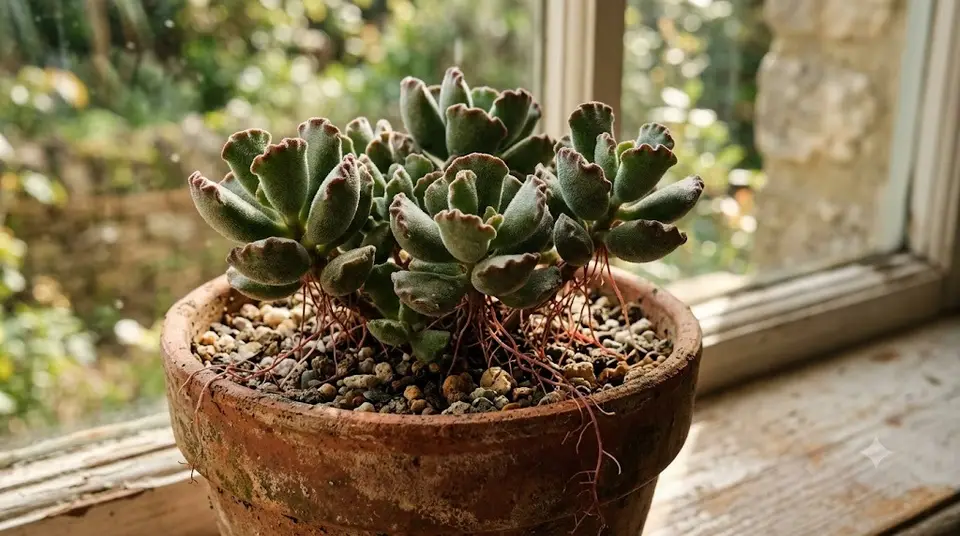
The crinkle-leaf plant is a small, slow, charming succulent grown for its wedge-shaped, wavy-edged leaves covered in fine silvery fuzz, clustered on short stems that often sprout reddish aerial roots.
Last reviewed: October 2026
 AI illustration
 Overview
The crinkle-leaf plant is a small, slow, charming succulent grown for its wedge-shaped, wavy-edged leaves covered in fine silvery fuzz, clustered on short stems that often sprout reddish aerial roots. Compact, tactile and easy, it is a lovely little collector's succulent for a bright windowsill.
Origin & Natural Habitat
Adromischus cristatus is endemic to the Eastern Cape of South Africa (Wikipedia). LLIFLE's succulent encyclopedia narrows it to the lower Baviaanskloof and the Langkloof west of Humansdorp, where it grows in sheltered, shaded rock outcrops and on rocky slopes of the Eastern Cape succulent thicket, and notes that it is never common there. That sheltered, shaded home is the key to growing it well indoors.
Appearance
LLIFLE describes erect stems 2-5 cm tall, wrapped in a thick coat of reddish, tangled, wiry, hair-like aerial roots. The grey-green leaves are wedge-shaped to oblong, with a cut-off or rounded tip that is crisped and wavy, and the upper edge of the leaf is horny, undulating and often darker - the "crinkle" of the name. Young leaves can carry fine glandular hairs that usually wear off as they age. The tubular flowers come in spring on a long, thin stalk and are white with a touch of red or pink (Wikipedia, LLIFLE).
Why People Love It - Qualities & Benefits
People love the crinkle-edged, fuzzy, pebbly leaves, the quirky reddish aerial roots, and the compact, slow, easy habit. It is a delightful, characterful little succulent that packs a lot of texture into a small pot.
Care
Light
Bright, but not baking. LLIFLE says it grows best in partial shade and that strong midday sun can scorch it - which fits a plant from shaded rock outcrops. An east-facing window, or a bright spot a little back from a south window, keeps the leaves compact and crinkled without bleached patches. In real gloom the stems stretch and the leaves spread apart.
Watering
Let the mix dry out completely, then water thoroughly; in winter water much less, but not so little that the leaves shrivel (LLIFLE). Pour onto the soil rather than over the rosettes: the crisped leaf tips and the root-wrapped stems hold water where rot can start.
Soil & Potting
A cactus and succulent mix that drains fast (Wikipedia), in a small, shallow pot with a drainage hole. The aerial roots on the stems need no burying - keep the stems at the depth they already grow.
Humidity & Temperature
Ordinary dry room air and some air movement suit it; Wikipedia names good airflow alongside bright light. For winter, LLIFLE gives a minimum of 5 °C and says it survives short dips well below freezing, but there is no reason to test that indoors - keep it frost-free.
Feeding
A little goes a long way: a weak succulent fertiliser once or twice between spring and late summer, none in winter.
Repotting
Only when the clump has filled its pot, in spring. Ease it out with the root ball intact - the leaves snap off at a touch - and set it in fresh gritty mix at the same depth.
Propagation
From single leaves, which LLIFLE says root easily: twist off a healthy leaf, let the wound dry for a couple of days, then lay it on dry gritty mix in bright, indirect light and mist the surface lightly only once roots appear. A new rosette forms at the base of the old leaf.
Common Problems & Pests
Rot from soil that stays wet is the usual killer. Bleached or brown, scorched patches mean too much midday sun (LLIFLE warns it can sunburn). Stretched stems with gaps between the leaves mean too little light. Leaves that drop when brushed are normal for the genus - pot them up. Check the leaf bases and stems for mealybugs.
Toxicity & Safety
It is generally regarded as non-toxic to people and pets, so it is a safe choice where children and animals are around - still, discourage cats and dogs from chewing it.
Pros & Cons
Pros: crisped, wavy leaf tips and fuzzy young leaves, red aerial roots on the stems, happy in a bright spot out of harsh midday sun, roots easily from a leaf, generally non-toxic. Cons: leaves snap off at a touch, rots in wet soil, can scorch in strong midday sun, slow to fill a pot.
Best Suited For
A bright room without a scorching south windowsill - an east window or a lightly shaded shelf - for anyone who likes texture and an odd little plant that grows new ones from fallen leaves.
FAQ
What are the reddish threads on the stems? Aerial roots: LLIFLE describes the stems as wrapped in reddish, tangled, wiry, hair-like roots. They are normal and harmless, and not every form has them - var. zeyheri grows without.
Full sun or shade? Bright light, but out of strong midday sun: LLIFLE says it grows best in partial shade and can sunburn at midday.
Gear for growing crinkle-leaf plant
Links go to Amazon or a partner store (such as Adagio Teas) and may earn us a commission at no extra cost to you. As an Amazon Associate we earn from qualifying purchases. We link gear types, not sponsors' picks: you choose the exact product.