Bear's Paw
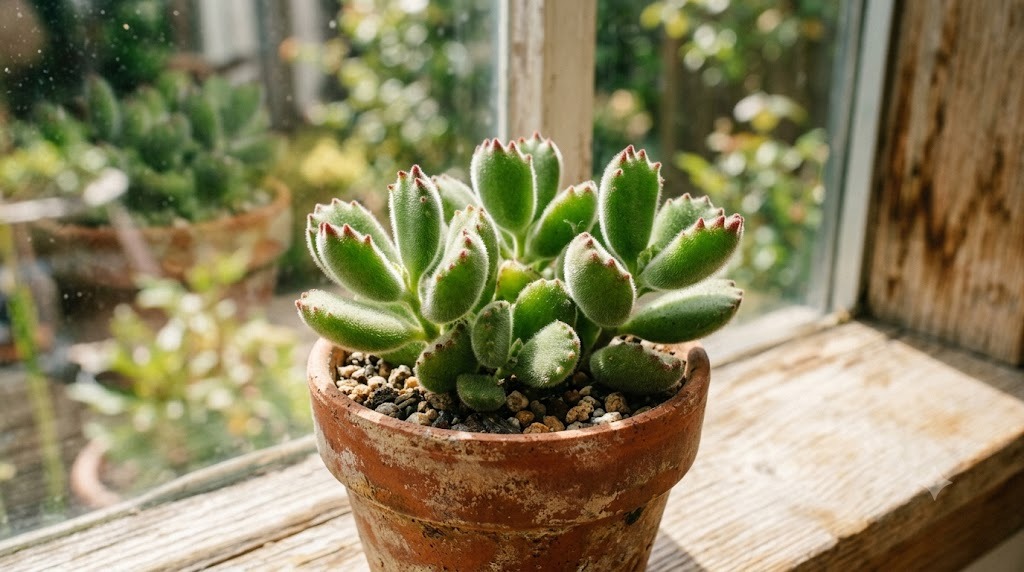
Bear's paw is an irresistibly cute succulent whose chunky, fuzzy leaves are tipped with rows of little reddish 'claws', so each leaf looks like a small bear's paw.
Last reviewed: October 2026
Overview
Bear's paw is an irresistibly cute succulent whose chunky, fuzzy leaves are tipped with rows of little reddish 'claws', so each leaf looks like a small bear's paw. Compact, easy and endearing, it is a popular novelty succulent for a bright sill - though, like its cotyledon relatives, it is toxic to pets.
Origin & Natural Habitat
Cotyledon tomentosa is a plant of the semidesert Little Karoo in South Africa (Wikipedia). The common bear's paw, subsp. tomentosa, grows in gravelly soil in arid thicket; the rarer subsp. ladismithiensis is confined, according to LLIFLE, to a small area south of Ladismith and a few spots near Laingsburg, on rocky outcrops. LLIFLE warns that many plants sold under that second name are in fact ordinary subsp. tomentosa.
Appearance
A small, branching shrublet of plump, oval leaves covered in dense soft hair, each ending in a row of reddish teeth - Wikipedia counts 3-8 on subsp. tomentosa, LLIFLE up to 10 - which is where the "claws" come from. The bell-shaped flowers hang in clusters on a stalk above the leaves and can be red, orange or yellow; in South Africa they open from July to September (Wikipedia).
Why People Love It - Qualities & Benefits
People adore the plump, fuzzy, claw-tipped leaves and the charming paw shape, along with its easy, compact, forgiving nature. Its tactile texture and cuteness make it a favourite novelty and gift succulent.
Care
Light
As much light as you can give it indoors. LLIFLE says it does well in full sun and copes with some shade, though in shade the leaves stay greener and the claws less red, and in harsh sun the leaves can turn pale yellowish. A south or west window suits it; in a dim room it leans and stretches.
Watering
It follows the Cape rhythm rather than a summer one: LLIFLE describes Cotyledon tomentosa as dormant in summer. Water well when the mix has dried out during its growing months, give much less in the heat of summer while it rests, and be careful in winter - roots are lost if the soil stays cold and wet (LLIFLE). Keep water off the hairy leaves.
Soil & Potting
A gritty cactus mix, or ordinary potting soil cut with at least as much grit or pumice, in a terracotta pot with a hole. Gravelly ground is what it grows in at home (Wikipedia), and a clay pot dries out between waterings the way that ground does.
Humidity & Temperature
Dry air and moving air suit it; LLIFLE pairs bright light with ample airflow. In winter, LLIFLE gives a minimum of about 5 °C and says it will take a light frost in dry soil, but frost scars the leaves - a cool, bright room is better than a cold balcony.
Feeding
It needs very little: half-strength cactus feed two or three times while it is growing, nothing during the summer rest or in winter.
Repotting
Every two or three years, at the start of its growing season rather than in high summer, into the next size of clay pot. Hold it by the base of the stems - fingerprints and scuffs stay on the felted leaves.
Propagation
Stem cuttings are the sure way: LLIFLE says the plant is easily increased by cuttings, which root easily. Take a short branch tip, let the cut dry for several days, then set it in dry gritty mix and water lightly once it resists a gentle tug. Single leaves will also root in sandy soil (LLIFLE), more slowly.
Common Problems & Pests
Rot from cold, wet soil is the main way to lose it, especially in winter. Soft, collapsing leaves in summer usually mean watering during its rest. Mealybugs hide in the hair at the leaf bases - dab them with alcohol on a cotton bud. Pale yellow leaves point to harsh sun, long gaps between leaves to too little light.
Toxicity & Safety
Treat it as poisonous. Wikipedia lists Cotyledon tomentosa as poisonous to livestock, dogs and humans because of its cardiac glycosides, and LLIFLE calls the plants highly poisonous to humans and domestic animals. Keep it out of reach of pets and children, and call a vet or poison line if anything chews it.
Pros & Cons
Pros: felted, claw-tipped leaves, compact and slow, roots easily from cuttings, hanging bell flowers on mature plants. Cons: poisonous to pets and people, rests in summer and needs less water then, rots in cold wet soil, leaves mark easily.
Best Suited For
A sunny windowsill in a home without curious pets or small children - and an owner who will remember to hold back the water in high summer.
FAQ
Is bear's paw toxic to cats and dogs? Yes. Wikipedia lists the plant as poisonous to dogs and humans (cardiac glycosides); keep it out of reach and call a vet if a pet chews it.
Why does it sulk in summer? It is resting: LLIFLE describes Cotyledon tomentosa as dormant in summer. Water lightly until the weather cools and new growth starts.
Gear for growing bear's paw
Links go to Amazon or a partner store (such as Adagio Teas) and may earn us a commission at no extra cost to you. As an Amazon Associate we earn from qualifying purchases. We link gear types, not sponsors' picks: you choose the exact product.