Baby Toes
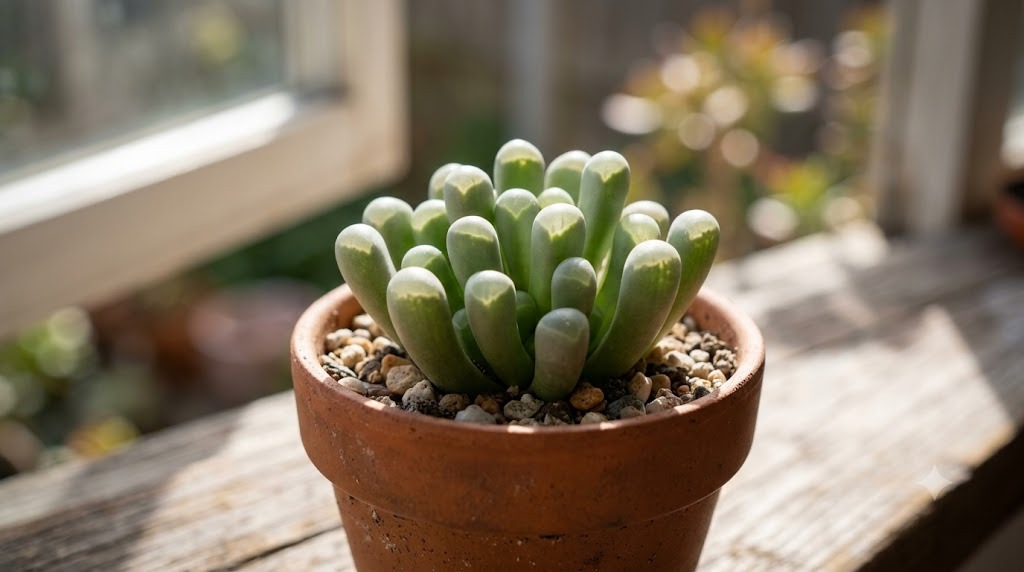
Baby toes is an oddball little succulent that grows a cluster of upright, finger-like leaves, each capped with a translucent 'window' at its flattened tip.
Last reviewed: October 2026
Overview
Baby toes is an oddball little succulent that grows a cluster of upright, finger-like leaves, each capped with a translucent 'window' at its flattened tip. In the wild the plant sits buried in sand with only those windows showing, letting light down into the leaf. Quirky and charming, it is a real conversation piece - if you master its dislike of overwatering.
Origin & Natural Habitat
Fenestraria rhopalophylla is a mesemb from the coastal deserts of Namibia and South Africa, where it grows almost buried in sandy soil with just the leaf windows exposed to the sun. It is adapted to fog, sharp drainage and long dry spells.
Appearance
Tight clusters of upright, club-shaped, pale grey-green leaves, each flat-topped and set with a translucent, jelly-like 'window' (fenestra) at the tip. Large, daisy-like white or yellow flowers open in autumn. The whole plant stays low and compact.
Why People Love It - Qualities & Benefits
People love the strange, translucent-tipped leaves and the clever window adaptation, the neat clustering habit, and the cheerful daisy flowers. It is a small, fascinating collector's succulent unlike anything else on the sill.
Care
Light
Give bright light with some direct sun (a sunny windowsill), so the tight, upright leaves stay firm and colour well. Too little light makes the leaves stretch, splay and lose their neat form.
Watering
This is the make-or-break: water very sparingly, only when the leaves start to soften or pucker, and let the very gritty soil dry out completely between drinks. It rots at the slightest excess and needs almost no water in the heat of summer or the cold of winter; water most in its cooler growing spells.
Soil & Potting
A very gritty, sharply draining mineral mix (even mostly pumice, grit or coarse sand) in a pot with drainage. Ordinary potting soil holds far too much water for it. Sharp drainage is the single most important thing.
Humidity & Temperature
Dry, airy conditions suit it; it dislikes humidity and stuffy air. Ordinary dry room air is fine. Keep it frost-free and quite dry over winter.
Feeding
Feed very lightly, if at all - a much-diluted feed once in the growing season is ample. It thrives on lean, poor soil and resents richness.
Repotting
Repot only occasionally, in the growing season, when the clump fills the pot. Handle gently and settle it into fresh gritty mix, waiting several days before watering.
Propagation
Propagate by dividing an established clump into rooted sections, or from seed. Division is simplest: separate a piece with roots and pot it into gritty mix, keeping it barely moist until settled.
Common Problems & Pests
Overwatering is the number-one killer - burst, mushy, split or rotting leaves are the classic sign of too much water. Give far less than instinct suggests. Stretched, floppy leaves mean too little light; sunken, wrinkled ones mean it is finally ready for a drink.
Toxicity & Safety
Baby toes is not toxic to people or pets, making it one of the safer curiosities to grow around children and animals - though it is always best to discourage pets from chewing houseplants.
Pros & Cons
Pros: fascinating window-tipped leaves, compact and tidy, cheerful daisy flowers, non-toxic. Cons: very intolerant of overwatering (rots easily), needs almost pure grit and a careful hand, dislikes humidity.
Best Suited For
A rewarding little curiosity for collectors and careful waterers who want something truly unusual - best for those willing to keep it lean, gritty and dry rather than heavy-handed with the watering can.
FAQ
Why did my baby toes leaves burst or turn to mush? Overwatering - they split and rot with excess water; water far less and use almost pure grit.
What are the clear tips for? They are 'windows' that let light into the buried leaf - a desert adaptation from its sand-dwelling home.
Gear for growing baby toes
Links go to Amazon or a partner store (such as Adagio Teas) and may earn us a commission at no extra cost to you. As an Amazon Associate we earn from qualifying purchases. We link gear types, not sponsors' picks: you choose the exact product.