Agave
Agaves are bold, architectural succulents that form dramatic rosettes of thick, pointed leaves, often edged with teeth and tipped with a sharp spine.
Last reviewed: October 2026
Overview
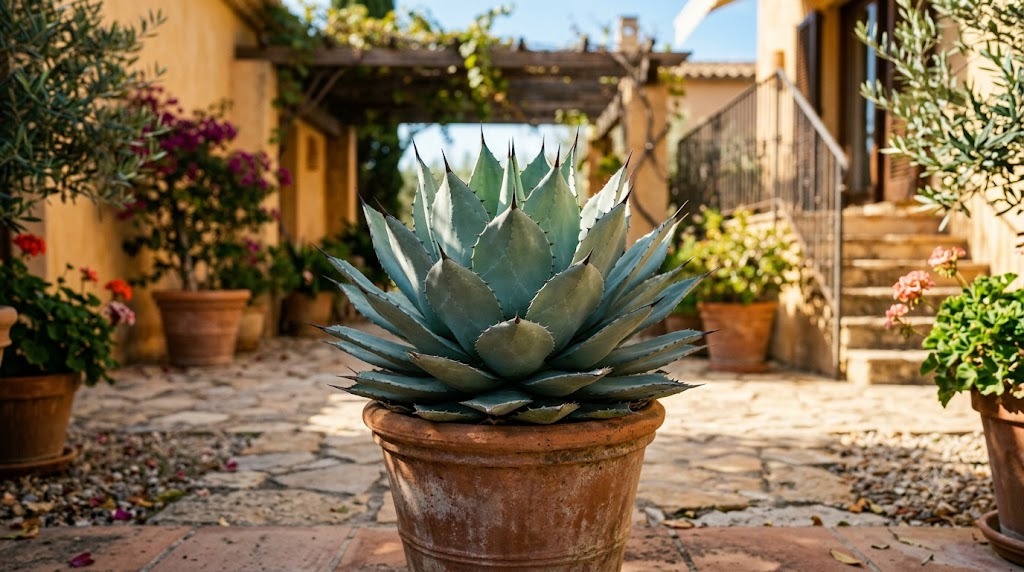
Agaves are bold, architectural succulents that form dramatic rosettes of thick, pointed leaves, often edged with teeth and tipped with a sharp spine. Slow-growing, extremely drought-tolerant and sculptural, a potted agave is a striking, low-care statement plant for a very sunny spot.
Origin & Natural Habitat
Agaves are native to the hot, arid regions of the Americas, especially Mexico and the southwestern US. They are adapted to intense sun and long drought, storing water in their fleshy leaves.
Appearance
A symmetrical rosette of thick, stiff, fleshy leaves in blue-green, grey-green or variegated forms, most with sharp marginal teeth and a hard, needle-like terminal spine. Sizes range from compact tabletop species to large specimens. Most flower only once, after many years, then die (monocarpic), usually leaving offsets behind.
Why People Love It - Qualities & Benefits
People love the strong, geometric, architectural form and the near-indestructible, drought-proof nature. A single agave brings sculptural drama to a sunny windowsill, patio or gravel garden with almost no care.
Care
Light
Give the most direct sun you can - a hot, south-facing window or a summer spot outdoors keeps the rosette tight, firm and well-coloured. In poor light it grows loose, pale and floppy.
Watering
Water sparingly: soak, then let the soil dry out completely, roughly every couple of weeks in summer and rarely in winter. Agaves store water in their leaves and rot quickly if kept wet - underwatering is far safer.
Soil & Potting
A gritty, very free-draining cactus or succulent mix in a pot with a drainage hole. Sharp drainage is essential to prevent root and crown rot.
Humidity & Temperature
Warm, dry air suits them; they dislike humidity. Ordinary room air is fine. Many tolerate cool winters, but keep frost-tender potted species above about 5°C and drier in winter.
Feeding
Feed lightly, if at all - a dilute feed once in the growing season is plenty. Agaves thrive on lean conditions and resent overfeeding.
Repotting
Repot only every few years when pot-bound, in spring, handling with great care because of the sharp teeth and terminal spine (many growers blunt the tip for safety). Remove offsets at the same time.
Propagation
Very easy from the offsets ('pups') that appear around the base - detach one with a few roots and pot it up. Species can also be grown from seed, though offsets are quicker and reliable.
Common Problems & Pests
Overwatering rot at the crown and roots is the main danger. Agave snout weevil and scale can affect them. Brown, mushy centres signal rot; shrivelled, folding leaves signal thirst (easily fixed).
Toxicity & Safety
Agaves are mildly toxic - the sap can irritate skin and, if chewed, the mouth and gut of pets and people, and the leaf tips and teeth can cause serious puncture injuries. Keep well away from children and pets, handle with care, and consider blunting the sharp tips.
Pros & Cons
Pros: bold architectural form, extremely drought- and neglect-tolerant, easy to propagate from pups. Cons: sharp teeth and spines are genuinely hazardous, sap can irritate, most are monocarpic (flower once then die), can get large.
Best Suited For
Ideal for anyone wanting a dramatic, near-indestructible statement succulent for a very sunny window, patio or gravel garden - as long as the sharp tips are sited safely away from people and pets.
FAQ
Is it dying because it's flowering? Possibly - most agaves are monocarpic and die after their once-in-a-lifetime bloom, but they usually leave pups behind.
Are the spines dangerous? Yes - the tips can puncture; many people trim or blunt them and site the plant out of the way.
Gear for growing agave
Links go to Amazon or a partner store (such as Adagio Teas) and may earn us a commission at no extra cost to you. As an Amazon Associate we earn from qualifying purchases. We link gear types, not sponsors' picks: you choose the exact product.