LECA for Houseplants: Full Guide
What LECA and semi-hydro actually are, which houseplants convert well and which to leave in soil, the step-by-step transfer, hydro nutrients, and the classic beginner mistakes.
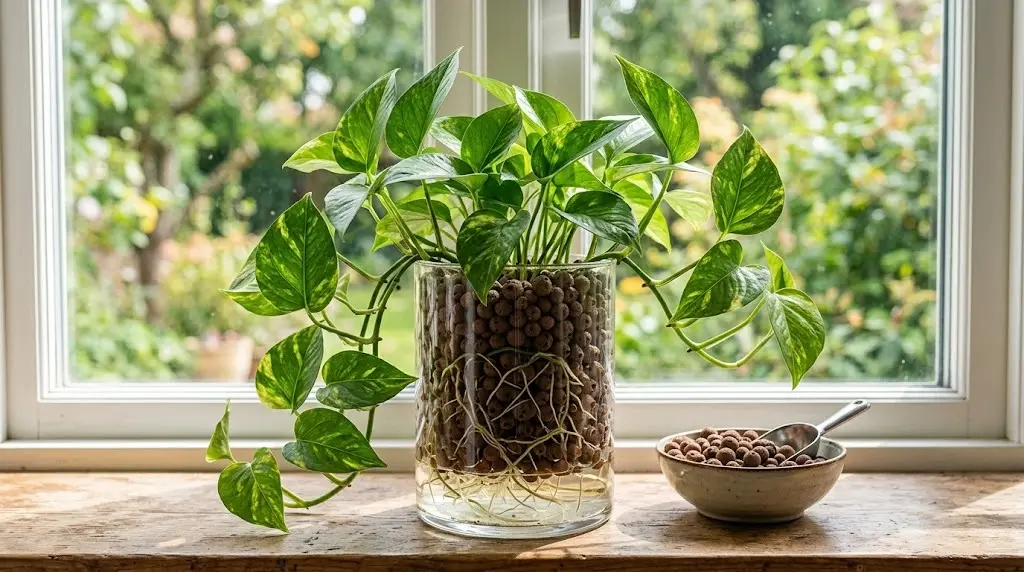
LECA (lightweight expanded clay aggregate) is baked clay balls that replace potting soil: the balls sit in a pot with a water reservoir at the bottom, wick moisture up to the roots, and leave air gaps everywhere else - which is why the method is called semi-hydroponics. The honest pitch: fewer fungus gnats (they breed in soil, and there is no soil), near-impossible overwatering, roots you can actually inspect, and watering that drops to every 1-3 weeks. The honest cost: converted plants sulk for 2-8 weeks while they grow new water-adapted roots, you must buy proper hydroponic fertilizer because LECA contains zero nutrition, and some plants are simply better left in soil. Here is the full picture, including the transfer steps and the mistakes that kill first attempts.
How Semi-Hydro Actually Works
A standard setup is two parts: an inner net pot (or any pot with plenty of holes) full of LECA holding the plant, sitting inside an outer cachepot with no drainage that holds a reservoir of nutrient water in the bottom third. Clay is capillary-active: the balls touching water pull it upward and pass it along, so the root zone stays evenly moist while never sitting submerged. Roots get constant moisture and constant oxygen - the combination soil only manages briefly after perfect watering. When the reservoir is dry, you refill it. That is the whole maintenance loop, minus a monthly flush we will get to.
You can also skip the net pot and plant directly into a glass vessel - pretty, and it lets you watch roots and water level - but glass grows algae in bright light and offers no easy way to lift the plant for flushing. Beginners do better with the two-pot system.
Which Plants Convert Well (and Which Do Not)
The best candidates share two traits: they tolerate root disturbance, and they naturally like the moist-but-airy root zone - or already grow adventitious/water roots easily.
Reliably good in LECA:
- Aroids - pothos, philodendrons, monsteras, ZZ plants, aglaonemas, anthuriums: the classic semi-hydro plants; most convert smoothly
- Hoyas - epiphytes that love the airflow around roots
- Orchids - already grown in bark for the same airy-moist logic; phalaenopsis in particular adapt well (keep the reservoir low)
- Snake plants and most sansevierias - counterintuitive but proven, because in LECA “wet feet” never actually happens; keep reservoirs modest
- Spider plants, syngoniums, peace lilies, most begonias - straightforward
- Anything you can root in water - a cutting rooted in water transitions to LECA almost without a hiccup, which is why cuttings are the single best way to start (more in our propagation guides)
Think twice or skip:
- Succulents and cacti - possible for experienced growers with shallow reservoirs and long dry gaps, but the moisture logic runs against everything they want; beginners lose these
- Ferns - want even moisture everywhere, not a wet bottom and airy top; most sulk hard
- Calatheas and other fussy prayer plants - already drama-prone; the conversion shock plus mineral sensitivity makes them a poor first (or fifth) candidate
- Very large, established, root-bound plants - the bigger and older the root system, the rougher the transition; convert your monstera’s cutting, not the six-footer
- Plants currently struggling. The rule that overrides every list: never convert a sick plant. Conversion is a stressor; it finishes off strugglers. Stabilize first, or take a healthy cutting instead.
Species-by-species care sheets, including water and humidity preferences that carry over to semi-hydro, are in our plant library.
The Conversion, Step by Step
- Prep the LECA (day before). Rinse it in batches until the water runs clear - new LECA is coated in clay dust that will otherwise turn your first reservoir to silt. Then soak it in clean water for at least a few hours, ideally 24: dry LECA pulls moisture from roots on contact. Some growers boil or oven-bake first-use LECA; a thorough rinse-and-soak is the reasonable minimum.
- Unpot and bare-root the plant. Ease the root ball out, crumble away soil gently, then rinse the roots under lukewarm water until no soil remains - between roots, in crevices, everywhere. This step decides your success: soil left on roots stays soggy against them in the humid LECA environment and becomes the rot nucleus of the whole setup. Take your time; ten extra minutes here saves the plant.
- Trim honestly. Cut off any mushy, brown, or damaged roots with clean scissors. Healthy soil roots will mostly die back anyway (this is expected - see below), but rot must not ride along.
- Pot up. A layer of damp LECA in the net pot, plant held centered at its previous depth, LECA filled in around the roots with gentle tapping to settle - never pressing hard; the balls should support, not crush. The root crown sits above the eventual water line, always.
- Set the water line. Fill the cachepot so the reservoir touches only the bottom quarter to third of the LECA - below the lowest roots for the transition period. The wicking does the delivery; the roots should chase the water down, not sit in it.
- Transition mode (weeks 1-4+). Plain water only for the first 2-4 weeks (a very dilute nutrient mix from week two is also defensible; plain is safer). Bright indirect light, no direct sun stress, high ambient humidity helps. Top-water gently through the LECA once or twice a week at first to keep upper roots from drying while new ones grow downward.
What to expect, honestly: some drooping, a yellowed leaf or two, and stalled growth for 2-8 weeks. Soil roots are furry and built for soil; the plant now grows smoother, whiter water roots, and the changeover costs it. You may even see some old roots rot off while new ones emerge - pull obvious mush out if accessible, but do not repot in panic. The plant has turned the corner when you spot crisp white root tips through the pot and new leaf movement up top.
Feeding: Non-Negotiable and Different
LECA is inert - zero nutrition, forever. Your fertilizer is now the plant’s entire diet, which changes two things:
- It must be a true hydroponic fertilizer - one containing all essential nutrients including calcium, magnesium, and the full micronutrient set. Ordinary houseplant fertilizers assume soil is providing part of the menu and will slowly starve a semi-hydro plant. The label should read like a complete periodic-table field trip.
- Feed weakly, constantly. The standard approach: nutrient water at roughly 1/4 to 1/2 of the label’s hydroponic strength in every reservoir refill, year-round at reduced winter strength, rather than occasional strong doses. Optional but genuinely useful once you are invested: a cheap pH pen - University of Illinois Extension gives a pH of 5.5-6.5 as what most plants prefer in hydroponics, and adjusting is a two-drop affair. Skip the pH rabbit hole for your first months; add it when you are hooked. Dosage and dilution calculators live in our tools section.
Maintenance and the Monthly Flush
Because water evaporates and plants drink selectively, mineral salts concentrate in the reservoir and on the clay over time - the cause of crusty white deposits and mysteriously crisped leaf tips. The fix is the monthly flush: lift the net pot, pour a generous volume of plain water through the LECA (sink or shower), let it drain, dump and rinse the cachepot, refill with fresh nutrient water. Five minutes, once a month, prevents the main long-term failure mode.
Otherwise: top up the reservoir when dry (after transition, roots reach the water and you can maintain a deeper reservoir), wipe algae from glass, and enjoy watching roots like a lava lamp. LECA itself is reusable indefinitely: after a plant moves out, rinse thoroughly, then boil or soak in diluted hydrogen peroxide or bleach solution (rinsing well after) to sterilize, dry, and store.
The Classic Beginner Mistakes
- Soil left on the roots. The classic killer. Rinse until paranoid.
- Water line touching the crown or covering roots on day one. Reservoir low; let roots chase it.
- Regular fertilizer, or none. Both starve or burn; hydro formula, low dose, every refill.
- Converting the prized, struggling, or giant plant first. Start with a pothos cutting you would not mourn.
- Skipping the rinse/soak of new LECA. Dust silts the reservoir; dry balls steal root moisture.
- Panic-repotting during the sulk. Weeks 2-5 look worse before they look better; disturbing the plant mid-transition restarts the clock.
- Never flushing. Salt buildup is slow, invisible, then suddenly brown-tipped.
The Short Version
- Semi-hydro = clay balls + bottom reservoir + wicking: airy, gnat-free, hard to overwater.
- Convert aroids, hoyas, orchids, and anything that roots in water; leave ferns, calatheas, succulents, and sick plants in soil.
- The transfer: rinse and soak LECA, bare-root completely, low water line, plain water first, expect a 2-8 week sulk.
- Feed a complete hydroponic fertilizer at 1/4-1/2 strength in every refill; flush monthly.
- Start with cuttings and cheap plants; graduate to the monstera later.
🛒 Recommended Gear on Amazon
- LECA clay pebbles - browse current options and reviews on Amazon.
- Hydroponic nutrients - browse current options and reviews on Amazon.
- Net pots - browse current options and reviews on Amazon.
As an Amazon Associate, we earn from qualifying purchases - at no extra cost to you. This helps us keep producing free, in-depth guides.